

When you look at the history of perimeter security, one area has traditionally been a massive blind spot: the undercarriage of a vehicle. For decades, checking the bottom of a car, truck, or bus for threats was a slow, awkward, and fundamentally flawed process.
Today, security demands speed, precision, and automation. At uvss.ai, we are witnessing a complete technological overhaul in how facilities monitor vehicle undersides. To understand where the industry is going—and why artificial intelligence is the new standard—it helps to look at how far under-vehicle scanning systems (UVSS) have come.
The Past: Mirrors on a Stick and “Good Enough” Security
For years, the gold standard of undercarriage inspection was a simple mirror attached to the end of a long pole. A security guard would walk around a vehicle, tilt the mirror, and try to catch a glimpse of anything out of place—contraband, improvised explosive devices (IEDs), or structural anomalies.
While cost-effective, this manual approach had severe limitations:
- Human Error & Fatigue: Guards looking at hundreds of cars a day inevitably miss small details.
- Poor Visibility: Mirrors offer no help in low light, rainy weather, or when looking into deep mechanical recesses.
- Safety Risks: The guard must stand directly next to an unvetted vehicle, putting them in immediate danger if a threat is present.
- Traffic Bottlenecks: Manual checks slow down entry points, causing major delays at high-traffic checkpoints.
Recognizing these vulnerabilities, the security industry looked to automation to replace the “mirror on a stick.”
The Transition: From Line-Scan to Digital Composites
The first major leap forward came with the introduction of digital camera systems embedded in the roadway.
Early digital UVSS utilized Line-Scan cameras. As a vehicle drove over the scanner, the camera captured the undercarriage line by line, stitching the pieces together like a mosaic to create a flat, static picture of the vehicle’s bottom.
While a massive upgrade from mirrors, line-scan technology struggled with vehicle speed. If a driver accelerated or braked while crossing the scanner, the resulting image would stretch or distort, making accurate inspection difficult.
To solve this, engineering shifted toward Area-Scan technology. Instead of capturing thin slices, modern area-scan systems capture multiple high-speed photographic fields and combine them into a single, high-resolution composite image. This eliminated speed distortion and gave operators a much clearer, highly reliable visual record of the vehicle.
The Present: 3D Depth Perception and Intelligent Integration
We are currently in a new era of under-vehicle inspection, characterized by the shift from flat 2D images to 3D stereoscopic depth vision.
Traditional UVSS relied entirely on visual contrasts. If an object was the same color as the vehicle’s chassis, an operator might miss it. Modern 3D UVSS technology solves this by capturing relative depth data. Using advanced sensors, the system maps the undercarriage as a 3D point cloud model.
[Vehicle Approaches] ──> [High-Speed 3D Area Scan] ──> [AI Depth & Anomaly Detection] ──> [Instant Security Alert]
This technological evolution brings several critical advantages to high-security facilities:
1. True Depth Analysis
Instead of just looking at colors and shadows, modern systems measure the physical geometry of the undercarriage. If a package or foreign object is attached to the frame, the system detects the physical change in depth and flags it immediately—even if it is painted to match the car.
2. Eliminating Occlusions
Vehicles are full of complex edges, recesses, and exhaust components. Dual-view and multi-angle 3D cameras can look “around corners” and view angles that would otherwise remain hidden or occluded in standard 2D views.
3. Smart Software Ecosystems
Modern scanning doesn’t happen in a vacuum. Advanced UVSS setups seamlessly integrate with:
- Automatic Number Plate Recognition (ANPR): Instantly tying the undercarriage scan to a specific license plate.
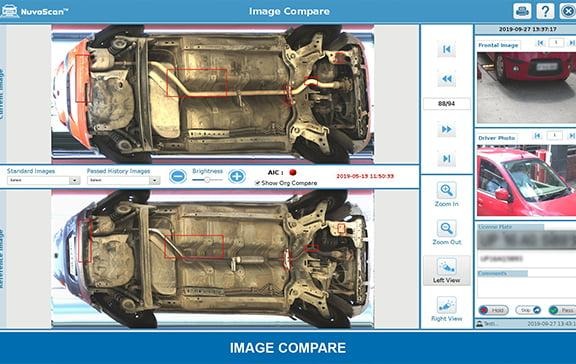
- Historical Vehicle Matching: Automatically comparing the current scan against a database image of the exact same vehicle from a previous visit to highlight any new modifications or attachments.
The Future: AI-Driven Automation at uvss.ai
The next milestone for under-vehicle surveillance isn’t just about capturing better images; it’s about what we do with those images. The ultimate goal is to remove human error entirely from the initial detection phase.
By leveraging Artificial Intelligence (AI) and Machine Learning (ML), modern systems can automatically recognize a vehicle’s make and model, cross-reference its standard manufacturing layout, and instantly alert security personnel to any deviations. This tiered, automated approach ensures maximum throughput at gates without compromising an ounce of safety.
From government buildings and military facilities to corporate campuses and transportation hubs, the demand for reliable, rugged, and intelligent scanning is higher than ever. At uvss.ai, we are dedicated to pushing the boundaries of what is possible, ensuring that your perimeter defense is prepared for the threats of tomorrow.
UVSS
✉️ Email: sales@uvss.ai
📞 Call: 00447944834433
💬 WhatsApp: https://wa.me/00447944834433
🌐 Visit: https://uvss.ai
AI UVSS Under Vehicle Surveillance System
