

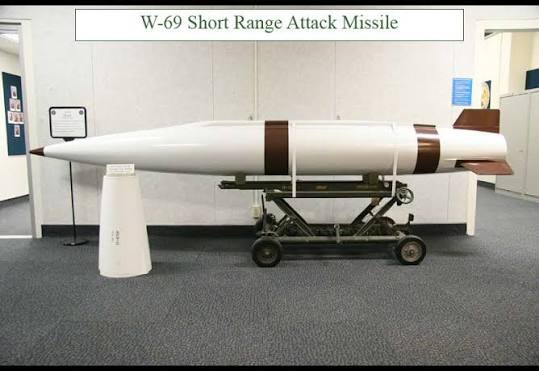
The W69 is a significant piece of Cold War history, representing a specific era in the development of tactical nuclear weapons. This article provides a comprehensive overview of the W69 nuclear warhead, covering its design, purpose, specifications, and eventual retirement.
The Genesis and Purpose of the W69
The W69 nuclear warhead was designed in the early 1970s by the United States as the payload for the AGM-69 SRAM (Short-Range Attack Missile) . The primary goal of this missile system was to give American strategic bombers, such as the B-52 and the FB-111, a means to penetrate increasingly sophisticated Soviet air defenses during the Cold War . The missile, and by extension its warhead, was intended to destroy surface-to-air missile sites and other critical air defense assets along the bomber’s flight path, clearing a way to their primary targets . The weapon entered the U.S. nuclear stockpile in 1972, and approximately 1,500 units were produced .
Technical Specifications of the W69
The W69 warhead was a marvel of miniaturization for its time, designed to fit within the relatively small confines of the SRAM. Its technical specifications made it a compact but powerful weapon .
- Dimensions and Weight: The W69 had a diameter of 15 inches (380 mm) and was 30 inches (760 mm) long, weighing 275 pounds (125 kg) . These dimensions allowed the AGM-69 missile to be carried in large numbers by strategic bombers.
- Yield and Design Origin: The warhead had a variable yield, typically cited as being between 170 and 200 kilotons of TNT (710–840 TJ) . Other sources mention a lower yield of 17 kilotons for a fission-only primary, and up to 210 kilotons when the fusion secondary was fully boosted with tritium . The W69 is believed to have been derived from the design of the B61 nuclear bomb, a versatile and widely deployed weapon in the U.S. arsenal .
The Delivery System: AGM-69 SRAM
The W69’s effectiveness was intrinsically linked to its delivery platform, the AGM-69 SRAM .
- Missile Capabilities: The AGM-69 was a two-stage, solid-fuel rocket that could reach speeds of up to Mach 3 . Its range was approximately 160 kilometers (100 miles), allowing bombers to launch attacks from outside the immediate range of many air defense systems . The inertial guidance system guided the missile to its target with a Circular Error Probable (CEP) of 430-450 meters, which was more than sufficient for a nuclear warhead of its yield .
- Carriage: The SRAM was designed to be carried by several types of U.S. Air Force strategic and tactical bombers, including the B-52, FB-111A, and later the B-1B Lancer . A single bomber could carry multiple missiles, increasing its ability to saturate enemy defenses with a single sortie.
Retirement and Dismantlement
The W69 and the AGM-69 SRAM were retired from active service in the early 1990s. A key reason for this early retirement was a safety concern regarding the warhead’s design. The W69 did not incorporate modern “fire-resistant” pits for its plutonium core, which meant that in the event of a severe aircraft fire or accident, the plutonium could be scattered over a wide area . The weapon was officially removed from the stockpile between 1991 and 1994 .
Following its retirement, the W69 underwent a multi-stage dismantlement process across several U.S. Department of Energy sites to ensure safety and environmental protection .
- Pantex Plant: The initial dismantlement, which involved the removal of high explosives from around the plutonium pits, was completed by 1999 . The plutonium pits were subsequently placed into secure storage.
- Y-12 National Security Complex: The most sensitive part of the dismantlement process was the disassembly of the “canned subassemblies” (CSAs), which contained the weapon’s secondary stage materials. The Y-12 Complex, which had originally assembled many of these components in the 1970s, began the complex and hazardous work of disassembling the CSAs in 2012 . This final stage of dismantlement was successfully completed in 2016, officially ending the lifecycle of the W69 warhead .
Conclusion
The W69 nuclear warhead was a product of its time, a powerful and compact weapon designed to ensure the survivability of the U.S. bomber fleet in a high-stakes Cold War environment. Its development and deployment highlight the intense focus on both strategic reach and the miniaturization of nuclear technology. The W69’s eventual retirement and complete dismantlement underscore a shift in strategic priorities and a continued focus on improving the safety and security of the U.S. nuclear arsenal. Today, the W69 serves as a historical example of the complex engineering and strategic calculus that defined the nuclear arms race.
