

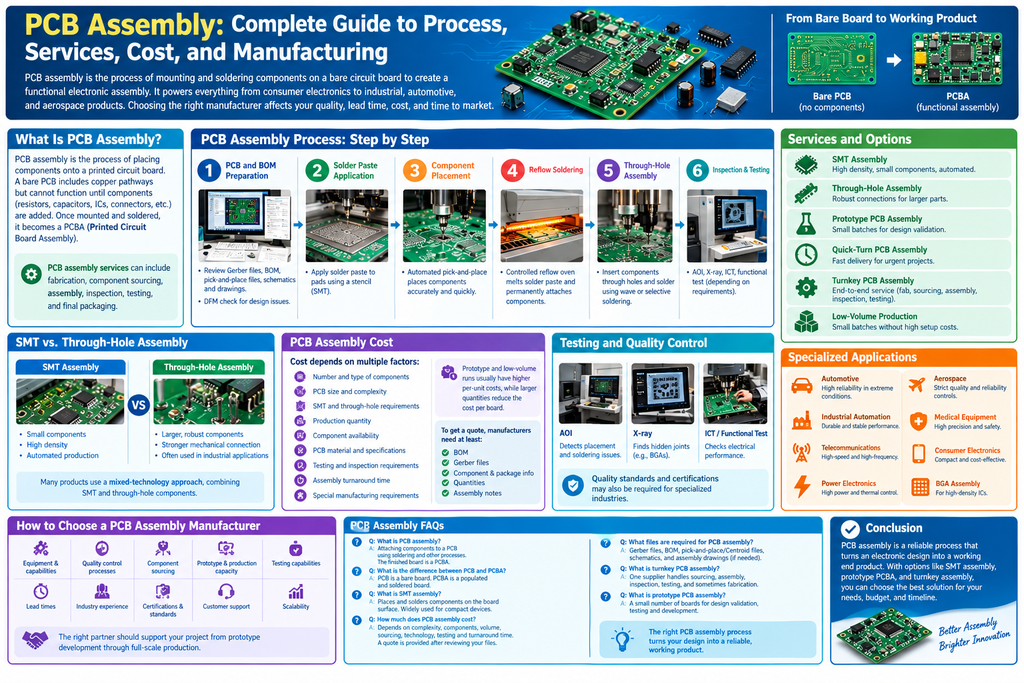
PCB assembly is an indispensable process that underpins modern electronics. In this process, components are mounted on bare circuit boards, forming the functional basis of every electronic product, from personal electronics to industrial equipment to automotive and aerospace products.
Choosing a reliable PCB assembly manufacturer matters whether you’re assembling a prototype, a medium production run, or a large-scale production. Your decision regarding manufacturer quality, lead time, production costs, and time to market is all determined by how well or poorly you manufacture an assembled PCB.
In this PCB assembly guide, we describe available services, what they involve, the costs, the technologies offered within these services, and what to do before choosing a manufacturing partner.
What Is PCB Assembly?
PCB assembly is the process of placing components onto a printed circuit board. A bare PCB includes printed pathways of copper or other materials for connections. This bare circuit board will not function until components such as resistors, capacitors, integrated circuits, connectors, and other components are added.
Once components are mounted and soldered, the result is called a PCBA (Printed Circuit Board Assembly).
Professional PCB assembly services can include PCB fabrication, component sourcing, assembly, inspection, functional testing, and final packaging.
PCB Assembly Process: Step by Step
A typical PCB assembly process involves several stages:
1. PCB and BOM Preparation
We also provide a manufacturer review based on Gerber files, bill of materials (BOM), pick-and-place files, schematics, and drawings. A DFM check may highlight design issues that impact manufacturing. We offer free DFM checking.
2. Solder Paste Application
For surface-mount technology (SMT) assembly, solder paste is applied to specific pads on the PCB using a stencil.
3. Component Placement
An automated pick-and-place machine places components accurately onto the solder-pasted board. This enables manufacturers to assemble complex boards rapidly and precisely.
4. Reflow Soldering
The populated PCB passes through a controlled reflow oven. Heat melts the solder paste and permanently attaches the components to the board.
5. Through-Hole Assembly
Some products require through-hole components. These components are inserted through holes in the PCB and soldered using methods such as wave or selective soldering.
6. Inspection and Testing
The assembled boards can go through AOI, X-ray, IC flying probe test, and functional testing, depending on the requirements.
SMT Assembly vs. Through-Hole Assembly
SMT assembly is widely used in modern electronics because it supports small components, high component density, and automated production.
Conversely, through-hole technology (THT) is generally selected when a component requires a robust connection, such as specific connectors and larger components.
Many products use mixed-technology PCB assembly, combining SMT and through-hole components to achieve the required electrical and mechanical performance.
Prototype and Quick-Turn PCB Assembly
To confirm the design and identify potential flaws, a company will likely use prototype PCB assembly before implementing it in full-scale production.
Prototype PCBA allows engineers to test component selection, functionality, assembly quality, and product performance before moving into mass production.
Quick-turn PCB assembly is especially valuable when design and development schedules are tight. Fast manufacturing is extremely valuable to startups, engineering firms, and many corporations alike, reducing development times and increasing time-to-market for new products.
For products requiring smaller quantities, low-volume PCB assembly can provide a practical way to manufacture small batches without immediately committing to high-volume production.
Turnkey PCB Assembly and Component Sourcing
In turnkey assembly, one manufacturing partner will handle all or nearly all of the manufacturing process. This often includes PCB fabrication, component sourcing, PCB assembly, inspection, programming and functional testing. Component sourcing is an essential part of modern PCBA manufacturing, and a proficient supplier can act on the consumer’s behalf to maintain control of the bill of materials, qualify acceptable substitutes when components are discontinued, and minimize supply-chain disruptions. Turnkey assembly is therefore appealing to corporations that want minimal procurement complications.
How Much Does PCB Assembly Cost?
PCB assembly cost depends on several factors, so there is no single price for every project.
Common factors include:
- Number and type of components
- PCB size , layer count and complexity
- SMT and through-hole requirements
- Production quantity
- Component availability
- PCB material and specifications
- Testing and inspection requirements
- Assembly turnaround time
- Special manufacturing requirements
Prototype and low-volume production may have higher per-unit costs, while larger production quantities can reduce the cost per board.
To estimate PCB assembly costs, most manufacturers require, at a minimum: Bill of Materials (BOM), Gerber files, component and package information, quantities, and assembly notes.
PCB Assembly Testing and Quality Control
Quality control is essential for reliable PCBA manufacturing. A professional manufacturer should have appropriate inspection and testing procedures throughout production.
AOI can identify component placement and soldering issues, while X-ray inspection can detect hidden solder joints and problems beneath components such as BGAs.
For complex projects, we should check whether the assembled board meets the specified electrical requirements through functional testing.
Specialized industries may also require specific quality standards and manufacturing certifications.
Specialized PCB Assembly Applications
PCB assembly requirements vary by industry. Automotive PCB assemblies require high reliability because vehicle electronics may face extreme temperatures, vibrations, and harsh environmental conditions. Similarly, aerospace PCB assembly requires strict quality and reliability controls.
Other applications include industrial automation, medical equipment, telecommunications, consumer electronics, and power electronics. BGA assembly may also be required for advanced products using high-density integrated circuits.
How to Choose a PCB Assembly Manufacturer
When selecting a PCB assembly manufacturer, consider more than the quoted price. Evaluate:
- Manufacturing and SMT equipment
- Quality-control processes
- Component sourcing capabilities
- Prototype and production capacity
- Testing capabilities
- Lead times
- Industry experience
- Certifications and quality standards
- Customer support
- Ability to scale production
The right manufacturing partner should support your project from prototype development through full-scale production.
PCB Assembly FAQs
What is PCB assembly?
PCB assembly is the process of attaching electronic components to a printed circuit board using soldering and other manufacturing processes. The completed board is known as a PCBA.
What is the difference between PCB and PCBA?
A PCB is a bare printed circuit board without components. A PCBA is a PCB populated with electronic components and assembled through soldering.
What is SMT assembly?
SMT assembly uses surface-mount technology (SMT) to place and solder electronic components onto the surface of a printed circuit board (PCB); it is widely used for modern, compact electronic devices.
How much does PCB assembly cost?
When you ask a manufacturer about cost, they base it on board complexity, number of components, board volume, component sourcing, the technology required to assemble the board, any required testing, and turnaround time. We will provide a reliable quote after reviewing your project files.
What files are required for PCB assembly?
Most manufacturers prefer Gerber files, a Bill of Materials, pick-and-place/Centroid files, schematics, and, where necessary, assembly drawings.
What is turnkey PCB assembly?
Turnkey PCB assembly is a manufacturing service where one supplier manages major production requirements, including PCB Fabrication, component sourcing, PCB assembly, inspection, chip programming and functional testing.
What is prototype PCB assembly?
Prototype PCB assembly is the production of a small number of assembled boards for design validation, testing, and development before larger-scale manufacturing.
Conclusion
PCB assembly is a reliable process that turns an electronic design into a working, reliable end product. In their work, YINGSTAR Electronics offers four PCB assembly options: YINGSTAR Electronics offers four PCB assembly options, PCB assembly, turnkey PCB assembly, Prototype PCB assembly and Volume PCB Assembly, etc., and you can choose the option that best fits your needs.
