

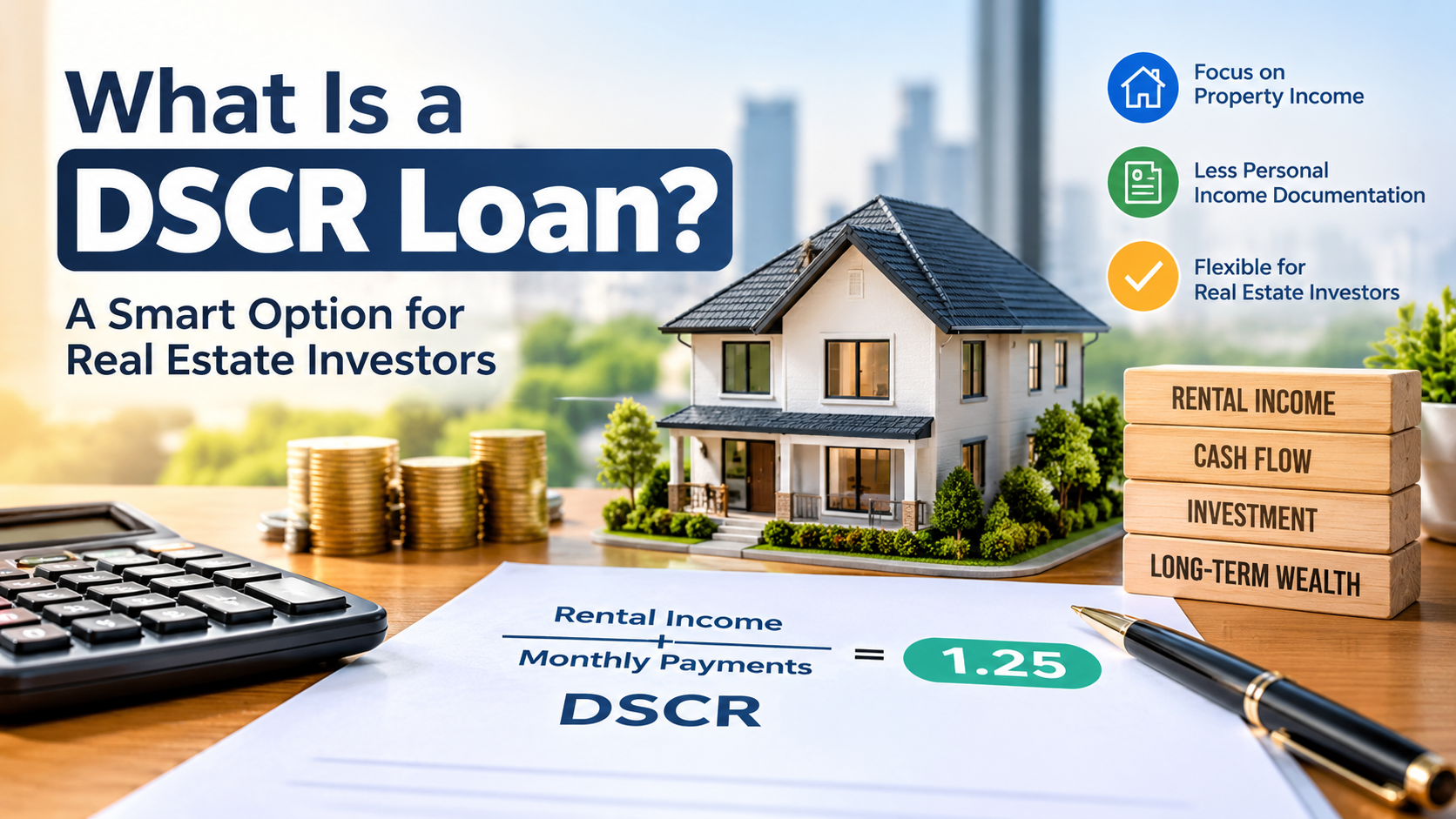
A promising rental property does not always fit neatly into a traditional mortgage application. You might own a profitable business, earn irregular commissions, or report substantial deductions that reduce your taxable income. Even when money is available for a down payment, documenting income can be an obstacle.
A debt-service coverage ratio (DSCR) loan offers another way to qualify. Instead of relying primarily on your paycheck, the lender focuses on the rental property’s income relative to its payment obligations.
Does that make DSCR the best loan program for real estate investors? Sometimes. Its advantages can be valuable, but the right choice depends on the property, financing costs, available cash, and your plans for ownership.
What Is a DSCR Loan?
A DSCR loan is financing designed around an investment property’s ability to support its debt. These programs commonly serve investors purchasing or refinancing rental properties.
Many DSCR lenders do not require the personal income documentation associated with traditional mortgages. For example, Kiavi describes its rental financing as focusing on property cash flow rather than personal income. That can make qualifying more practical for investors whose finances do not fit a standard employment profile.
However, reduced personal income documentation does not mean automatic approval. Lenders still evaluate the borrower and the property. Credit, cash available for closing, reserves, appraised value, property condition, and acceptable rental income can all matter.
DSCR also describes an underwriting approach, rather than one standardized national program. Two lenders may offer substantially different requirements, pricing, and repayment terms.
How Is DSCR Calculated?
For many residential rental loan programs, the calculation is:
DSCR = qualifying monthly rental income ÷ monthly PITIA
PITIA includes principal, interest, property taxes, insurance, and applicable association dues. Visio Lending uses this rent-to-PITIA approach in its explanation of residential DSCR financing.Source: Visio Lending
Consider a hypothetical rental property:
| Monthly amount | Example |
| Qualifying rental income | $2,500 |
| Principal and interest | $1,500 |
| Property taxes | $350 |
| Insurance | $150 |
| Association dues | $0 |
| Total PITIA | $2,000 |
The calculation is $2,500 ÷ $2,000 = 1.25.
That means qualifying rent equals 125% of the payment obligations included in this calculation. A ratio of 1.00 means rent exactly covers those obligations. Below 1.00, qualifying rent falls short.
Always ask which formula your lender uses. Commercial property underwriting may calculate coverage using net operating income and annual debt service, producing a different result.
A Passing DSCR Does Not Guarantee Profit
The most important distinction for investors is between qualifying for financing and earning an acceptable return.
In the example above, rent exceeds PITIA by $500 monthly. That amount is not necessarily spendable profit. The owner still needs to account for expenses such as:
- Vacancy and tenant turnover.
- Repairs and routine maintenance.
- Property management.
- Leasing expenses and owner-paid utilities.
- Future roof, appliance, and HVAC replacements.
Suppose the investor budgets $125 for vacancy, $200 for management, and $175 for maintenance and future replacements. The apparent $500 surplus disappears.
Those figures are illustrative, but the lesson is practical: build a separate operating budget. A lender’s qualifying ratio should be one part of your investment analysis, alongside realistic expenses and an emergency fund.
Why Investors Consider DSCR FinancingIt can accommodate complicated personal income
Self-employed investors may have healthy businesses but tax returns that require extensive analysis. Investors with multiple income sources can also face documentation challenges.
A DSCR program may reduce that burden by qualifying primarily through the rental property. It can be useful when personal income documentation is the obstacle and the property itself supports the proposed financing.
The benefit is easier alignment between the loan and the investment’s income. It does not eliminate the need to evaluate your overall financial capacity.
It may support entity ownership
Some investors want to hold rentals through a limited liability company. Certain DSCR lenders accommodate entity borrowers, although requirements vary by lender and location. Visio’s lending process, for example, identifies states where loans must close in legal entities.
Do not assume an LLC eliminates personal responsibility for the loan. Review any guaranty requirements and discuss ownership structure with qualified legal and tax professionals.
It offers several financing structures
DSCR financing can be used for purchases, refinances, and certain cash-out transactions. Depending on the lender, options may include fixed rates, adjustable rates, or interest-only payments.
Lima One publishes these choices within its rental lending programs, along with separate options for single properties, portfolios, and short-term rentals. Availability and terms depend on the specific transaction.
Matching the structure to your intended holding period matters as much as securing approval.
What Requirements Should Investors Expect?
There is no universal minimum credit score, down payment, or DSCR requirement across the market.
For a concrete lender-specific example, Lima One publishes a minimum DSCR of 1.00 for its rental loans and says properties at 1.20 or higher may qualify for its strongest pricing and leverage. It also advertises financing up to 80% loan-to-value for certain purchases and rate-and-term refinances. These are the lender’s guidelines, not industry-wide promises.
At 80% loan-to-value, a $300,000 purchase would require a $60,000 down payment if the purchase price and appraised value support that calculation. Closing costs and required reserves would be additional.
Expect the lender to explain how it establishes qualifying rent. Your projected rent may differ from the amount accepted after a review of leases, rental history, or market evidence.
What Are the Main Drawbacks?Financing costs can weaken the investment
Compare actual DSCR and conventional investment-property quotes. A convenient qualification process may come with a higher rate, additional points, or other costs.
Even a modest difference in payment can materially affect returns when the property has a narrow monthly margin. Evaluate the total dollars spent over your expected ownership period, rather than choosing based on the advertised rate alone.
Include origination charges, appraisal costs, lender fees, and the cash required at closing. Ask each lender to price the same loan amount and repayment structure so the comparison is useful.
Prepayment penalties can restrict your exit
Some DSCR loans impose an early repayment charge. Visio explains that a prepayment penalty adds a fee for an early payoff. The structure and availability depend on the program and applicable restrictions.
Before signing, ask how a sale, refinance, or substantial principal payment would affect the penalty.
A lower rate may be less attractive if you expect to sell soon or refinance after renovations. Request a written payoff example for your anticipated exit date.
Payment structures introduce different risks
Interest-only payments can improve initial monthly cash flow, but they do not reduce principal during that period. Adjustable rates can change future payments. A balloon structure may require a large payoff before you otherwise intend to exit.
Lima One lists these structures among its rental financing options. Review the full payment schedule and maturity terms before comparing offers.
How Does DSCR Compare With Other Loans?
Conventional investment-property financing is worth considering when your documented income and financial profile support approval. Conventional underwriting can also recognize eligible rental income; it does not necessarily rely only on employment earnings. Fannie Mae maintains detailed rules governing the documentation and treatment of rental income.
Local bank or portfolio financing may be worth exploring for unusual properties or for those with established banking relationships.
For a property requiring substantial rehabilitation, acquisition-and-renovation financing may be a better fit for the initial project. Longer-term rental financing may become available once the work is complete and the property meets the lender’s requirements.
Compare financing for the property’s current condition and business plan.
What About Short-Term Rentals?
Some DSCR programs accept short-term rental properties, but qualification criteria can differ from those for long-term rentals. Lima One publishes a dedicated short-term rental program with its own leverage and underwriting parameters.
An attractive peak-season revenue projection is not enough to establish a dependable investment.
Evaluate annual occupancy, cleaning costs, platform charges, management costs, furnishing replacement costs, and seasonal demand. Verify local rental restrictions and association rules before committing to a purchase. Financing approval does not establish permission to operate a vacation rental.
Is DSCR the Best Choice?
DSCR may be a strong fit when a rental supports its financing, you have adequate cash reserves, and personal income documentation makes conventional approval difficult. It can also suit investors seeking an eligible entity ownership structure.
It becomes less appealing when financing costs consume the expected return, the property needs extensive work, or a prepayment penalty conflicts with your exit plan.
Stress-test the investment before borrowing. Reduce projected rent, add vacancy, increase taxes and insurance, and budget for a major repair. Then compare written loan offers using those conservative assumptions.
The best loan supports a durable investment through ordinary setbacks. DSCR can provide that financing, but the property’s economics and the terms you accept determine whether it is the right choice