

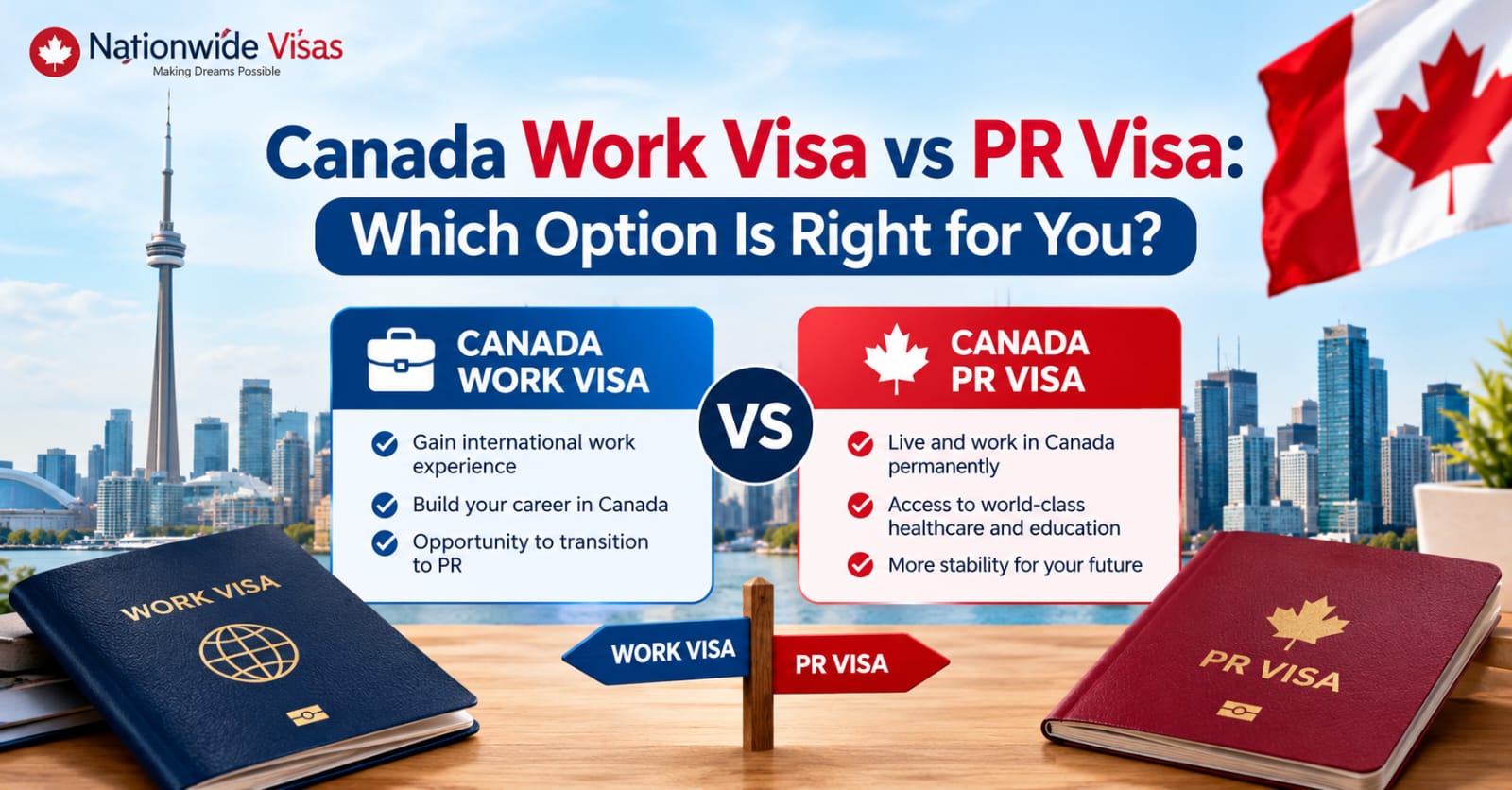
Selecting between a Canadian work visa and a Permanent Resident (PR) visa is based on your career plans, education and immigration goals. A work permit allows qualified professionals to work in Canada temporarily, while PR status offers the opportunity to work and live in the country permanently, subject to residency and other legal criteria.
Comprehending the differences between these options can help you select a pathway that aligns perfectly with your circumstances.
What is a Canada Work Visa?
A Canada work visa usually refers to a work permit that allows an international professional to work in Canada under the authorized conditions. Work permits are primarily classified into two different categories.
- Employer-specific work permit: Allows you to work for the same businessman named on your permit, subject to its conditions.
- Open work permit: Allows you to work for eligible employers, with limited restrictions. It is available only to people who fulfill specific eligibility requirements.
Depending on the permit type, you might require a job offer, an employer specific approval or other relevant documentation. A work permit is temporary and does not automatically provide permanent residence.
What is a Canada PR Visa?
A Canada PR visa refers to permanent resident status, which authorizes qualified professionals to live, study or work anywhere in Canada, subject to applicable laws and restrictions.
Skilled professionals can explore different immigration routes, including
- Express Entry Program
- Provincial Nominee Program
- Other eligible economic immigration programs.
Every pathway has its own requirements relating to:
- Education
- Work experience
- Language skills
- Other relevant factors
PR holds can get the advantage of several social amenities, subject to eligibility criteria.
However, they are not allowed to vote in federal elections or certain jobs which require high level security clearance. They must also satisfy Canada’s residency obligation to maintain their status.
Canada Work Visa vs PR Visa: Key Differences
Although both options can help in building a better future in Canada, their conditions and long term benefits differ.
| Factor | Canada Work Visa | Canada PR Visa |
| Immigration status | Temporary | Permanent, subject to legal requirements |
| Duration | Limited by permit validity | Can be maintained by meeting PR obligations |
| Employment | Based on permit conditions | Generally allows work for most businessmen |
| Job offer | Required for many, but not all, permits | Depends on the immigration pathway |
| Flexibility | May be restricted by employer or occupation | Greater employment flexibility |
| Long-term settlement | May provide a route to PR | Designed for permanent settlement |
A work permit might suit someone wishing for temporary employment or international experience. PR route might be more suitable for candidates who qualify for an immigration pathway and wish to establish a long-term career in Canada.
Who Should Choose a Canada Work Visa?
A work permit might be appropriate if you have a qualifying job offer, fulfilling the requirements for an employer specific permit or become eligible for an open work permit. It can help you in gaining Canadian work experience, develop professional connections and earn a good salary while working legally.
However, it is advised to candidates that they should check the permit’s conditions, validity and extension options before applying. They should also check whether their circumstances could assist in future PR applications rather than assuming that Canadian employment automatically guarantees PR.
Who Should Apply for Canada PR?
PR might be a good option for skilled workers who fulfill the eligibility requirements of an economic immigration program and wish to settle permanently.
Candidates researching a Canada Occupation in Demand route should keep in mind that having a sought after occupation does not automatically qualify them for PR. Eligibility criteria depends on the intended program, profession requirements where applicable, work experience, language skills and other selection factors.
- Express Entry manages applications under the following:
- Federal Skilled Worker Program
- Canadian Experience Class
- Federal Skilled Trades Program as well as certain provincial nominations.
PNPs can offer another route for applicants who satisfy a territory’s requirements.
Can a Canada Work Visa Lead to PR?
Yes, some temporary workers might become eligible for PR through Express Entry or a PNP. For instance, the Canadian Experience Class is made for qualifying applicants with Canadian work experience.
However, holding a work permit alone is not enough. Candidates must satisfy the criteria of the immigration pathway they choose, including applicable work experience, language and other criteria.
How Can You Decide Which Option is Right for You?
Start by assessing your qualifications, work experience, language scores, job offer and long term immigration goals. An online CRS Score calculator can help you discover your CRS score for Express Entry, it cannot guarantee an ITA or establish requirements for every immigration program.
Conclusion
A Canadian work permit offers different employment opportunities on a temporary basis, on the other hand PR offers a route to long term settlement. The correct choice depends on your career goals and long term immigration goals. It is advised to review the official requirements carefully before making any route final to pursue.
If you are unsure which route to pursue, Canada PR Consultants in India can help you understand the available immigration options, assess program criteria and prepare your application. Always verify your eligibility and the latest requirements through official IRCC resources.
