

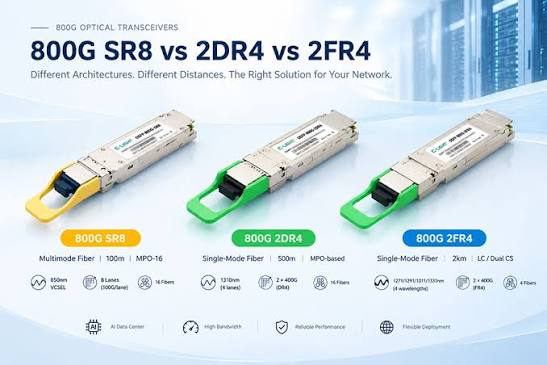
As data center networks scale to support larger GPU clusters and higher east-west traffic, switch interconnects must deliver greater bandwidth without making fiber infrastructure unnecessarily complex. The 800G 2xFR4 optical transceiver offers a practical approach by combining two independent 400G FR4 optical engines in one OSFP module. With duplex LC connectivity and a reach of up to 2 km over single-mode fiber, it provides a flexible option for high-speed switch-to-switch links.
Two 400G Optical Engines in One 800G Module
Unlike a conventional single-engine optical design, an 800G 2xFR4 module contains two separate 400G FR4 optical interfaces. Each engine supports a 400G link using four wavelength channels in the 1310 nm band, with multiplexing and demultiplexing integrated into the optical system.
Each 400G engine uses one duplex LC connection, so the complete module requires two duplex LC fiber pairs to establish both links. This architecture enables an 800G-capable module to serve two independent 400G optical connections, subject to the host platform’s supported configuration. For switch interconnects, it can simplify port planning while maintaining a familiar duplex LC cabling approach.
Reducing Fiber Management Complexity
Parallel-optics solutions often use multi-fiber connectors such as MPO, which can be effective for high-density applications but require careful attention to polarity, lane mapping, and breakout configurations. By contrast, 2xFR4 uses two duplex LC connections, making it easier to integrate into existing single-mode LC-based cabling infrastructure.
This can simplify patch-panel planning, labeling, and routine maintenance. Network teams can identify each 400G optical path separately, helping isolate faults without treating the entire 800G connection as a single undifferentiated link. However, the design does not eliminate the need for proper cable management: both LC pairs must be routed, labeled, and tested correctly.
When planning a new installation, reserve sufficient panel capacity and cable pathways for both links. Keep fiber routes organized, avoid excessive bending or tension, and document which LC pair corresponds to each optical engine. These practices make later troubleshooting and expansion more predictable.
Planning for Reach and Optical Loss
An 800G 2xFR4 module can support transmission distances of up to 2 km over single-mode fiber, making it suitable for many intra-data-center connections between racks, network zones, or switch locations. The actual deployment must still satisfy the module’s optical specifications.
Calculate the complete link budget, including fiber attenuation, connector insertion loss, patch panels, and any intermediate connections. Measure the real cable route rather than estimating distance from rack positions alone. Both 400G paths should be planned carefully, with comparable routing where possible to avoid unnecessary differences in path length and latency.
Before installation, verify connector cleanliness, LC/UPC compatibility, port configuration, and platform support. After connecting the fibers, check link status and available digital diagnostics to confirm that both optical engines operate as expected.
Simplifying High-Speed Network Expansion
For networks moving toward 800G connectivity, 2xFR4 optics offer a useful balance between bandwidth, reach, and cabling flexibility. A compatible 800G Twin-port OSFP module, such as the MMS4X50-NM, can support switch interconnect designs for appropriate Quantum-2 InfiniBand or Spectrum-4 Ethernet platforms, provided the exact system configuration is validated.
By combining two 400G optical links in one module and using familiar duplex LC single-mode cabling, 800G 2xFR4 can make long-reach interconnect planning more manageable. Careful port mapping, optical-budget calculations, and consistent fiber documentation remain essential to building a reliable, maintainable network.
