

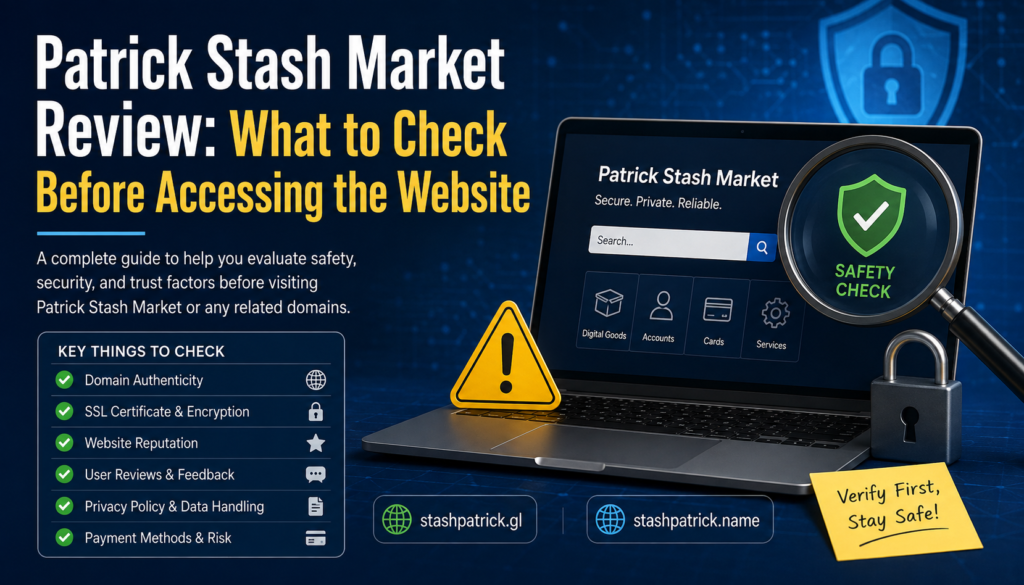
The internet makes it easy to discover new websites, marketplaces, and online services, but easy access does not always mean safe access. Before opening an unfamiliar platform, users should consider its reputation, domain history, security configuration, privacy practices, and overall credibility. Searches related to Patrick Stash Market, Stashpatrick Shop Security, and similar terms highlight why careful website evaluation is important.
A website can look professional while still presenting privacy, security, or trust concerns. Likewise, a domain name appearing in search results does not prove that it is official, legitimate, or safe. Users should therefore evaluate unfamiliar sites independently rather than relying on branding, promotional claims, or links shared through third parties.
This review focuses on practical checks users can perform before accessing an unfamiliar website. It does not endorse Patrick Stash Market, stashpatrick.gl, stashpatrick.name, or any similarly named service. Instead, the goal is to help readers recognize warning signs and make more informed browsing decisions.
Why Website Verification Matters
Online platforms can change rapidly. A domain that appears in a discussion today may disappear tomorrow, redirect somewhere else, or be replaced by another address. This is particularly important when users encounter phrases such as Patrickstash New Domain while searching for a website.
Domain changes are not automatically evidence of wrongdoing. Legitimate businesses sometimes move because of rebranding, technical changes, acquisitions, or domain-management decisions. Frequent unexplained changes, however, deserve additional scrutiny.
Before visiting a newly promoted address, users should ask basic questions. Who operates the website? How long has the domain existed? Is there reliable information about the organization behind it? Does the site have clear policies and contact information?
Independent verification becomes especially important when a website handles personal details, account credentials, payment information, or other sensitive data.
Understanding Stashpatrick Shop Security
When researching Stashpatrick Shop Security, users should look beyond whether a page loads successfully or displays a padlock symbol. HTTPS encryption is useful because it protects information traveling between a browser and a website, but it does not establish that the website itself is trustworthy.
A broader security review should examine several factors:
- Whether the website uses a valid HTTPS certificate
- Whether browsers or security services report suspicious behavior
- Whether the domain has a consistent history
- Whether privacy and account policies are clearly explained
- Whether contact and ownership information can be reasonably verified
- Whether the site requests unnecessary personal or financial information
A professionally designed interface should never replace these checks. Modern website templates make it relatively easy for almost anyone to create a polished appearance.
Users should also be cautious about downloading files, browser extensions, mobile applications, or software from an unfamiliar source. Such downloads can create greater risks than simply viewing a webpage.
What a Stashpatrick CC Review Should Examine
Someone searching for a Stashpatrick CC Review may encounter very different opinions, claims, and promotional pages. Reviews can provide useful context, but their quality matters.
A trustworthy assessment should distinguish between independently verified facts and unconfirmed claims. It should also avoid treating anonymous comments as definitive evidence.
Look at when a review was published and whether the author provides evidence for important statements. A large number of nearly identical reviews posted within a short period can indicate artificial promotion. Excessively positive language without meaningful detail should also be treated cautiously.
Independent sources are generally more valuable when they explain both strengths and risks. Users should compare multiple sources instead of allowing a single Stashpatrick CC Review to determine whether they trust a website.
Evaluating a Patrickstash New Domain
A Patrickstash New Domain deserves the same verification process as any other unfamiliar web address. The fact that a new domain resembles the name of an older site does not prove that the same people control it.
Impersonation is a common online problem. Small differences in spelling, punctuation, domain extensions, or added words can lead users to completely unrelated websites.
When examining a newly promoted domain, check its exact spelling before opening it. Search independently for references to the address rather than relying exclusively on a link received through email, social media, messaging applications, forums, or advertisements.
Domain registration information may also provide useful clues. Although privacy services often hide registrant details for legitimate reasons, registration dates and other publicly available records can sometimes help users understand how recently an address appeared.
A very recent registration does not automatically make a website unsafe, but it can justify additional verification when combined with other warning signs.
Comparing Stash Patrick Market and Patrick Stash Market References
Search engines may display variations such as Stash Patrick Market and Patrick Stash Market. Similar naming creates an important verification problem because users may assume every variation refers to the same platform.
That assumption can be risky.
Fraudulent or imitation websites sometimes use names that closely resemble existing brands. The difference might involve only one letter, a different domain extension, an additional hyphen, or a reversed word order.
Before interacting with any site associated with these terms, compare the domain carefully with references from reliable sources. Avoid assuming that a website is authentic simply because its logo, colors, or page design resemble something you have seen previously.
Brand similarity should be treated as a starting point for investigation, not proof of identity.
Checking Domains Such as stashpatrick.gl
A domain such as stashpatrick.gl should be evaluated independently rather than trusted because its name looks familiar. The domain extension itself does not determine whether a website is trustworthy.
Start by checking whether your browser reports certificate errors, unusual redirects, deceptive-page warnings, or download prompts. Unexpected behavior deserves attention.
Users should also consider what happens immediately after opening a site. A page that instantly asks for sensitive credentials, financial information, cryptocurrency transfers, or software installation presents a higher level of risk than a normal informational webpage.
Avoid entering information merely to explore what a website contains. When uncertainty exists, security scanning and reputation-checking services can provide additional context without requiring direct interaction with the site.
What to Consider Before Visiting stashpatrick.name
The same principles apply to stashpatrick.name. Similar wording across domains does not establish common ownership or legitimacy.
Users should investigate whether the domain has a transparent purpose and whether reliable external sources connect it with the organization it claims to represent. Check for inconsistencies in branding, spelling, contact details, policies, and navigation.
Unexpected redirects are another important warning sign. If entering one address repeatedly sends the browser through several unrelated domains, users should avoid continuing until they understand why.
It is also sensible to keep browsers, operating systems, and security software updated. Modern browsers can block many known malicious pages, but technical protection should complement careful judgment rather than replace it.
Privacy Should Be Part of Every Website Review
Website safety is not limited to malware. Privacy deserves equal attention.
Before creating an account on an unfamiliar platform, determine what information it requests and whether that information is genuinely necessary. A website asking for excessive personal details without explaining why should raise questions.
Users should avoid reusing important passwords. If credentials from one website are exposed, reused passwords can allow attackers to attempt access to email, social media, financial, or other accounts.
Unique passwords and multi-factor authentication can significantly reduce this risk. These practices are particularly valuable when testing unfamiliar services.
Providing less information is also a useful security principle. If a website does not need a particular piece of personal information to provide its service, there is usually little benefit in voluntarily supplying it.
Common Warning Signs Users Should Recognize
Individual warning signs do not always prove that a website is dangerous. Several appearing together, however, can indicate a higher level of risk.
Pay particular attention to websites that show:
- Frequent unexplained domain changes
- Pressure to act or pay immediately
- Requests for unusual payment methods
- Poorly explained ownership or contact information
- Promises that appear unrealistic
- Unexpected software or file downloads
- Multiple redirects to unrelated domains
- Browser security warnings
- Requests for passwords or sensitive information without a clear reason
- Conflicting information across supposedly official pages
Users researching Patrick Stash Market or related names should apply these standards consistently. Familiar branding should never cause someone to lower normal security precautions.
How Search Results Can Create False Confidence
Search visibility is sometimes mistaken for legitimacy. A website appearing near the top of search results can feel more trustworthy simply because it is easy to find.
Search position, however, is not a security certification.
Promotional content, advertisements, discussions, copied reviews, and third-party pages can all appear prominently. Readers should therefore distinguish discoverability from credibility.
When researching Stash Patrick Market, Stashpatrick Shop Security, or Patrickstash New Domain, compare information from several independent sources. Look for consistency in dates, domain names, ownership claims, and reported experiences.
If sources contradict one another, treat the uncertainty itself as useful information and proceed cautiously.
Safer Habits Before Accessing an Unfamiliar Website
A simple verification routine can reduce unnecessary exposure to online threats. Before visiting or interacting with an unfamiliar website, confirm the exact domain name and investigate its reputation independently.
Keep your browser updated and pay attention to built-in warnings. Do not disable security protections simply because a webpage instructs you to do so. Avoid downloading unknown applications or files, and never provide sensitive information until you understand who operates the website and why the information is required.
For accounts that matter, use unique passwords and multi-factor authentication. If a website requires financial activity, conduct additional checks before providing payment details or transferring funds.
These habits are useful far beyond Patrick Stash Market. They provide a practical framework for evaluating almost any unfamiliar online service.
Making an Informed Decision Before You Visit
Researching terms such as Patrick Stash Market, Stashpatrick CC Review, Stashpatrick Shop Security, Patrickstash New Domain, Stash Patrick Market, stashpatrick.gl, and stashpatrick.name should begin with verification rather than assumptions.
A familiar name, attractive interface, HTTPS connection, positive review, or high search position cannot independently establish trustworthiness. Reliable evaluation requires several signals considered together, including domain history, technical security, reputation, transparency, privacy practices, and consistency across independent sources.
If important questions remain unanswered, there is no need to rush into creating an account, downloading a file, or providing personal information. The safest approach is to investigate first and interact only when there is enough reliable evidence to understand what the website is, who operates it, and what risks may be involved.
Careful browsing does not require advanced technical knowledge. It mainly requires patience, verification, and a willingness to stop when something does not look right. Those habits can make exploring unfamiliar websites considerably safer.
