

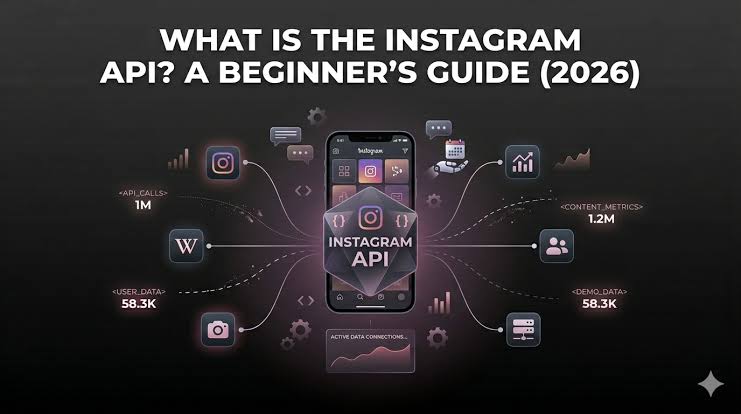
A few years ago, anyone who wanted to study Instagram at scale had two options: click through profiles by hand, or build a fragile scraper that broke every time the app changed its layout. Today a third option has moved into the mainstream. Instagram data APIs, services that return public profile and post information as clean, structured data, have become standard equipment for marketing teams, academic researchers, journalists, and independent developers. This explainer looks at what these interfaces expose, where their limits sit, and why demand for them keeps climbing.
What an Instagram data API actually is
The phrase sounds more technical than the reality. An API, or application programming interface, is simply a way for one program to ask another for information and get a predictable answer back. Instead of a human loading a profile page and reading the follower count off the screen, a script sends a request such as “give me the public details for this username” and receives a tidy block of text, usually in JSON format, listing the display name, bio, follower and following counts, number of posts, and whether the account is verified or private.
Meta operates its own official Graph API, which is powerful but tightly scoped: it is built mainly for businesses managing their own accounts and for approved partners, and it requires app review, access tokens, and a connected Business or Creator account. That is fine for a brand reading its own insights, but it does little for someone who wants to compare fifty public accounts in a category, or a researcher studying how hashtags spread across communities.
That gap is where third-party data APIs stepped in. Providers such as FastSocial, which is best known for its Instagram growth tools, also offer a public-data API with a free key, aimed at developers who need profile and post information without setting up the full Meta approval process. The pitch is practical rather than glamorous: quick setup, readable output, and enough coverage to power a dashboard or a research notebook.
Why demand took off
Three forces pushed these tools from niche to normal. The first is the professionalization of creator marketing. Agencies that once eyeballed an influencer’s profile now need defensible numbers before they sign a contract: follower growth over time, posting frequency, average engagement on recent posts, and whether the audience looks organic. Pulling that data manually for hundreds of candidates is not realistic, so the work moved to scripts and spreadsheets fed by APIs.
The second force is the research community. Communication scholars, public-health teams, and election watchdogs all treat Instagram as a primary source. They need reproducible methods, meaning a dataset that another team can rebuild using the same query. A documented API endpoint gives them exactly that, in a way that screenshots never could.
The third force is simpler: Instagram’s own web interface has become less friendly to casual browsing. Logged-out visitors are increasingly prompted to sign in, and the layout shifts often enough that homemade scrapers need constant repairs. A maintained API absorbs those changes so the people using it do not have to.
What these APIs typically expose
Coverage varies between providers, but most public-data APIs cluster around the same handful of objects. Understanding them helps you judge whether a tool fits your project before you write a single line of code.
- Profile metadata: username, full name, bio text, external link, profile photo URL, follower and following counts, total post count, verification status, and whether the account is private or flagged as a business.
- Post and Reel details: caption text, timestamp, media type, like and comment counts where they are publicly shown, view counts on video, and the hashtags and mentions contained in the caption.
- Public stories and highlights: on some services, the media currently visible in a public account’s highlight reels.
- Search and discovery helpers: username lookups, hashtag feeds, and sometimes location-tagged posts, which are popular with local-news and tourism researchers.
Notice what is missing from that list. Private accounts return almost nothing beyond the fact that they exist. Direct messages, saved collections, close-friends stories, and anything behind a login are out of reach, and any service claiming otherwise should be treated with suspicion. A legitimate data API reads the same information a stranger could see by visiting the profile; it just reads it faster and more consistently.
The limits that trip people up
The first limit is rate. Every provider caps how many requests you can make per minute or per day, and free tiers are naturally tighter than paid ones. A marketing analyst pulling a few hundred profiles a week will rarely notice; a researcher trying to snapshot a million accounts overnight will hit a wall quickly and should plan for batching, caching, and patience.
The second limit is freshness. Public counts on Instagram change constantly, and most APIs serve data that is seconds to minutes old rather than live. For trend analysis that is irrelevant. For a journalist trying to document a follower count at an exact moment, it matters, and the honest approach is to record the timestamp returned alongside the number.
The third limit is interpretation. An API tells you that a post has 4,200 likes; it does not tell you why. Likes, follows, and views on Instagram can be influenced by paid promotion, collaborations, viral luck, and growth services that sell engagement as social proof. Those services operate openly, and many brands use a modest, slow-delivered boost to make a new account look established while they build a genuine audience. Bought numbers are not a substitute for real engagement, though, and anyone analyzing accounts should look at the ratio of comments to likes, the consistency of growth, and the quality of replies rather than treating a single count as proof of influence.
Finally, there is the platform-policy question. Instagram’s terms restrict automated collection, and the legal landscape around scraping public data is still settling in the United States and elsewhere. Reputable providers stick to public information, honor privacy settings, and publish clear acceptable-use rules. Users of the data carry responsibility too: store only what the project needs, anonymize where possible, and never repurpose personal information in ways the account owner would not expect.
Use cases that have become routine
Influencer vetting is the most common commercial use. A brand compiles a shortlist, runs each handle through the API, and flags anything unusual: sudden follower spikes, a following count far larger than the follower count, or engagement that is suspiciously uniform across posts. The data does not make the final decision, but it narrows the list before a human reviews it.
Competitive benchmarking is a close second. Small businesses track five or ten peers in their niche, logging weekly follower counts and posting cadence to a simple spreadsheet. Over a quarter, that log reveals which content types are winning attention in the category, without any guesswork.
Newsrooms use the same endpoints for verification. When a screenshot of a viral post circulates, an editor can confirm the posting account’s real name, creation details, and public history in seconds. Academic teams use them to build longitudinal datasets on topics from body image to disaster response, and civic groups track how public officials communicate during emergencies.
Getting started without over-engineering
For most people the right first step is tiny. Request a free API key, make a single profile lookup, and read the response carefully to see which fields are present and how they are named. That one exercise answers most questions about whether the tool suits the project. Documentation such as this developer page shows typical request formats and the fields a lookup returns, which is enough to sketch a prototype in an afternoon.
From there, resist the urge to build a platform. A spreadsheet refreshed by a short script, or a notebook that charts follower counts over time, delivers most of the value with almost none of the maintenance. Store the raw responses with timestamps so you can re-analyze later, respect the rate limits you agreed to, and document your method so a colleague can reproduce it.
Instagram data APIs are not magic, and they are not surveillance. They are a faster, more reliable way to read what the platform already shows the public. Used carefully, they turn a feed full of impressions into something a marketer, a reporter, or a researcher can actually measure.
