

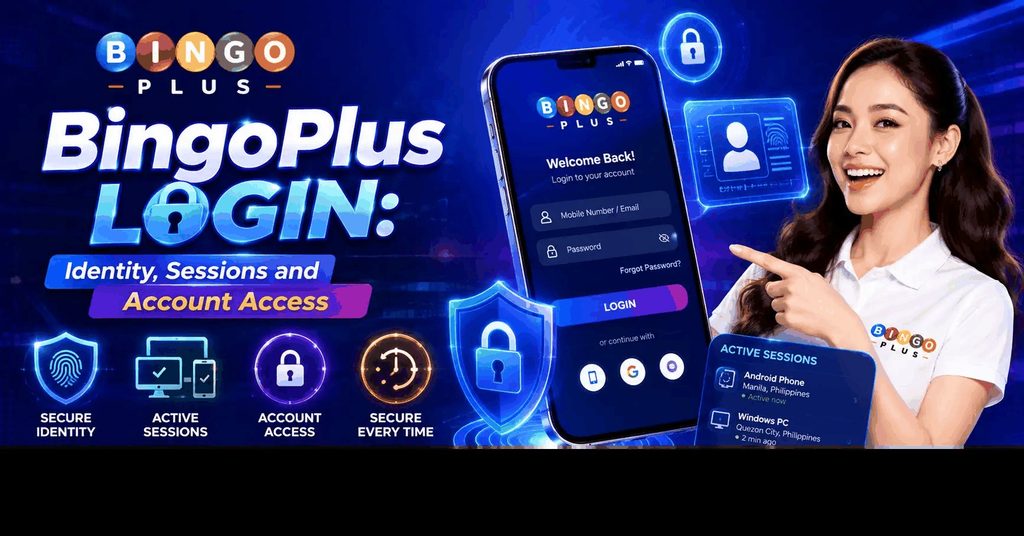
A login page may contain only a few visible elements, but the technology behind it is responsible for one of the most important tasks on a digital platform: confirming that the person requesting access is the legitimate account owner.
A secure BingoPlus login journey begins before any password is entered. Users must first identify the correct destination, confirm that the connection is protected and recognize whether the page belongs to the expected platform. The authentication system must then validate credentials, manage verification challenges, create a protected session and provide a safe recovery route when access is lost.
These processes form an identity and access management system. When designed correctly, they work together without placing an unreasonable burden on legitimate users.
What Digital Identity Means
A digital identity is the collection of verified attributes and credentials that represents a user within an online service.
It may include:
- Account identifier
- Verified phone number
- Verified email address
- Password credential
- Authorized devices
- Authentication history
- Recovery methods
- Security preferences
- Eligibility status
- Active sessions
Not every piece of information should be used for every login.
Authentication should request only what is necessary to establish the appropriate level of confidence. Additional verification may be required when a user changes a password, adds a new device or performs another sensitive action.
Identity data must be protected throughout its lifecycle, from initial registration to eventual account closure.
Authentication and Authorization Are Different
Authentication answers the question: “Who is requesting access?”
Authorization answers: “What is this authenticated user allowed to do?”
The distinction matters.
A user may successfully sign in but still need additional verification before changing security details or accessing a sensitive account function. Similarly, a customer-support representative may have limited access to assist with a case without being permitted to view a complete password or verification code.
A secure system applies authorization checks on the server.
Hiding a button in the interface is not sufficient protection. A determined person may attempt to call the underlying service directly.
Every protected action should verify both the session identity and the user’s permission to perform it.
Finding the Official Login Destination
Users frequently discover account pages through search engines, advertisements, bookmarks, messages and social media.
These routes can lead to copied or outdated pages.
Before using a Bingo Plus login page, users should inspect:
- The complete domain
- The spelling of the brand
- The use of HTTPS
- The final destination after redirects
- The visible security information
- The linked privacy and support pages
A copied page can reproduce the original logo, colors and layout. Visual similarity is not enough to establish authenticity.
HTTPS is essential because it encrypts information moving between the browser and server. However, a fraudulent website can also obtain a valid certificate.
The domain identity and encrypted connection must be evaluated together.
Understanding Lookalike Domains
Phishing websites often use names that resemble the expected domain.
Possible techniques include:
- Added words
- Missing letters
- Replaced characters
- Unusual hyphens
- Extra subdomains
- Misleading domain endings
- International characters resembling Latin letters
A long address can hide the actual registered domain.
Users should read from the domain ending toward the left and identify which organization controls the destination. Text appearing before the registered domain may be only a subdomain.
Search ranking is not proof of official ownership. Sponsored results require the same verification as ordinary results.
Building a Clear Login Interface
A login interface should focus on authentication.
Essential elements may include:
- Account identifier field
- Password field
- Password visibility control
- Sign-in button
- Recovery link
- Security guidance
- Official support route
Unrelated banners and excessive animation can distract users from the primary task.
Field labels should remain visible while the user types. Placeholder text alone can disappear and create confusion.
The page should also identify when Caps Lock may affect a password and provide understandable feedback when required information is missing.
A clear interface helps users recognize unexpected changes that could indicate they are on the wrong page.
Creating a Strong Password
A password should be unique to the account.
Reusing the same credential across several websites creates a major risk. If one unrelated service is compromised, attackers may test the exposed password elsewhere.
Strong passwords are generally:
- Long
- Unique
- Difficult to predict
- Unrelated to public personal information
- Stored securely
Users should avoid credentials based on:
- Names
- Birth dates
- Phone numbers
- Keyboard patterns
- Repeated characters
- Public social-media details
- Passwords used on another platform
A password manager can generate and store complex credentials without requiring users to memorize every one.
No support representative should ask for the complete password.
Password Storage on the Server
A platform should not store user passwords as readable text.
Passwords are typically processed through a specialized one-way hashing function with a unique salt. This approach allows the system to verify a submitted password without recovering the original value.
Secure password storage also requires:
- Modern password-hashing algorithms
- Appropriate computational cost
- Unique salts
- Restricted database access
- Credential rotation procedures
- Monitoring for unusual access
Ordinary encryption is not a direct replacement for password hashing. Encryption is reversible when the key is available, while a password hash is designed for verification rather than recovery.
If a platform can send an existing password back in readable form, that is a warning sign. A secure recovery process normally resets the password instead.
Adding a Second Authentication Factor
Multi-factor authentication uses more than one independent type of evidence.
The main factor categories are:
- Something the user knows, such as a password
- Something the user has, such as a registered phone
- Something the user is, such as a biometric characteristic
A second factor can reduce the risk created by a stolen password.
However, the quality of implementation matters. A verification code that users are encouraged to share with support provides little protection.
The system should explain when the factor is required and which action it confirms.
Unexpected authentication prompts should be treated cautiously.
Protecting One-Time Verification Codes
One-time passwords are frequently targeted through social engineering.
An attacker may claim that a code is needed to:
- Activate the account
- Cancel suspicious access
- Release a transaction
- Confirm a reward
- Update the application
- Verify customer identity
- Complete a support request
A legitimate system asks the user to enter the code only inside the verified interface for an action the user initiated.
The code should never be sent to another person through private chat, social media, email or an unverified phone call.
If an unexpected code arrives, the user should not share it. The safer response is to open the known official access route and review the account.
Considering Passkeys
Passkeys are a modern authentication method based on public-key cryptography.
Instead of sending a reusable password to the server, the user’s device proves possession of a protected private key. The corresponding public key can verify the login without revealing the private credential.
Passkeys can reduce exposure to:
- Password reuse
- Credential stuffing
- Many phishing attempts
- Weak password selection
- Password database theft
They may use a device PIN, fingerprint or facial recognition to authorize local use.
Platforms considering passkeys must still provide secure account recovery and device-management processes. Losing a phone should not permanently block the legitimate account owner, while recovery should not become an easy route for impersonation.
Understanding Biometric Login
Biometric authentication can make repeated mobile access more convenient.
A well-designed application normally relies on the operating system’s protected biometric service rather than independently storing a raw fingerprint or facial image.
Biometric access should be:
- Optional
- Clearly explained
- Bound to an authorized device
- Revocable
- Supported by another recovery method
A fingerprint or face scan generally unlocks a locally protected credential or session. It should not be interpreted as proof that biometric data is being sent directly to the platform.
Users should review the application’s privacy explanation and device settings before enabling this option.
Protecting the Login Request
Authentication data should travel through an encrypted connection.
The login process should also defend against:
- Request interception
- Credential replay
- Modified form submissions
- Automated password attacks
- Cross-site request forgery
- Session fixation
- Injection attacks
Security controls can include validated requests, anti-forgery tokens, rate limits and protected session cookies.
Detailed implementation should remain on the server rather than relying entirely on browser-side scripts.
Client-side validation improves usability, but an attacker can bypass it. The server must independently validate every login request.
Preventing Automated Login Abuse
Attackers may test large numbers of leaked username and password combinations. This is known as credential stuffing.
Other automated attacks may repeatedly guess credentials for one account.
Defensive measures can include:
- Rate limiting
- Progressive delays
- Device-risk analysis
- IP reputation signals
- Verification challenges
- Temporary protection
- Breached-password checks
- Security alerts
Controls should distinguish automation from ordinary human mistakes where possible.
A legitimate user who enters a password incorrectly should receive a useful recovery path rather than becoming permanently locked out without explanation.
Security responses should also avoid revealing whether a specific account identifier exists.
Designing Risk-Based Authentication
Not every login carries the same level of risk.
A familiar device using an expected network may require the normal credential. A request from a new device, unusual location or suspicious automation pattern may justify additional verification.
Risk signals can include:
- Device history
- Login timing
- Network reputation
- Repeated failures
- Location change
- Browser characteristics
- Unusual account activity
Risk-based authentication should not make decisions from one imperfect signal alone.
Mobile carrier routing and virtual private networks can make locations appear unusual. A new browser version can alter device characteristics.
The system should combine signals and provide a safe verification route for legitimate users.
Creating Secure Sessions
Successful authentication creates a session that allows the user to navigate without entering a password on every screen.
The session is commonly represented by a protected identifier stored in a cookie or secure application storage.
A session identifier should be:
- Random
- Difficult to predict
- Transmitted securely
- Protected from scripts where appropriate
- Renewed after authentication
- Invalidated after logout
- Limited by expiration rules
The session token should not appear in a public URL.
URLs may be copied, shared, stored in browser history or included in analytics logs. Sensitive session information belongs in protected storage and secure headers or cookies.
Choosing Session Timeouts
Sessions should not remain active indefinitely.
An inactivity timeout can end a session after the user has not interacted for a defined period. An absolute timeout can require reauthentication even when activity continues.
The correct duration balances security and usability.
Very short timeouts can interrupt legitimate use, especially on slower mobile networks. Excessively long sessions increase risk on lost or shared devices.
Sensitive actions may require recent authentication even when the general session remains valid.
The interface should warn users before an avoidable timeout where practical and preserve non-sensitive form progress safely.
Managing Trusted Devices
A trusted-device feature can reduce repeated verification on a personal phone.
Trust should never be permanent without user control.
A device-management area may show:
- Device type
- Approximate login time
- Recent activity
- Trust status
- Option to remove access
- Option to sign out remotely
Device names and locations may be approximate. They still provide useful context for identifying unfamiliar sessions.
Removing a trusted device should invalidate its relevant session or require additional verification the next time it attempts access.
Users should not mark public or shared devices as trusted.
Signing Out Correctly
Closing a browser tab does not necessarily end a server session.
A complete logout should:
- Invalidate the server-side session.
- Remove or expire the local session token.
- Clear relevant temporary account state.
- Return the user to a non-authenticated page.
- Prevent protected pages from reopening through browser history.
A “sign out everywhere” option can help after a lost device or suspected compromise.
Users accessing accounts on shared devices should always use the official logout control. Clearing browsing history alone may leave the server session active.
Securing Shared and Public Devices
Shared phones, borrowed computers and public terminals create additional risk.
Users should avoid:
- Saving passwords
- Enabling permanent trust
- Leaving an account unattended
- Downloading personal records
- Allowing notification previews
- Storing verification documents
- Remaining signed in
Public Wi-Fi adds another concern because deceptive network portals can imitate login pages.
Sensitive account actions are safer through a trusted connection. If a shared device must be used, the user should later review active sessions from a personal device.
Account Recovery Is Part of Authentication
A strong login system can be undermined by a weak recovery process.
Attackers may target password reset because it provides another route into the account.
A secure recovery process may involve:
- Verified contact ownership
- Additional identity checks
- Device history
- Recovery codes
- Waiting periods for high-risk changes
- Support review
- Security notifications
Recovery should request only proportionate information.
Identity documents should not be sent to an unknown person through an ordinary messaging application. The upload route should be connected to the verified platform and explain how the information will be used.
Changing a Registered Phone or Email
Updating a recovery phone number or email address is a sensitive action.
The platform may require:
- Current authentication
- Additional verification
- Notification to the old contact method
- Confirmation through the new contact method
- Temporary restrictions
- Review of active sessions
A security notification should provide a route for reporting an unauthorized change.
Links inside unexpected messages should still be treated cautiously. Users can open the known domain directly and navigate to account security.
The old contact method should not lose protection silently before the new one is verified.
Avoiding Account Enumeration
Account enumeration occurs when an interface reveals whether a particular phone number, email address or username is registered.
An attacker can use this information for targeted phishing or credential attacks.
Login and recovery messages should avoid unnecessary confirmation.
Instead of saying “This email has an account,” a neutral message may explain that recovery instructions will be sent if the supplied information matches an eligible account.
Neutral responses must still be understandable to legitimate users. Security should not produce an interface so vague that users cannot determine the next safe step.
Handling Failed Login Attempts
A failed login message should help without exposing sensitive details.
Useful guidance may include:
- Check the account identifier
- Confirm Caps Lock status
- Try the password again
- Use the verified recovery process
- Wait after repeated attempts
- Contact official support if access remains unavailable
The message should not recommend trying many password variations rapidly.
Repeated failure can trigger temporary protection. The duration and recovery path should be explained without revealing internal security thresholds.
Users should investigate unexpected failed-login alerts because another person may be attempting access.
Recognizing Phishing Messages
Phishing often creates urgency or fear.
Common claims include:
- “Your account will close today.”
- “Confirm your password immediately.”
- “Send the code to stop a transaction.”
- “Use this new login link.”
- “Your balance will expire.”
- “Install this security update.”
- “Support needs remote access.”
Users should pause when a message demands immediate action.
The safe response is to open the known platform address independently. Replying to the message or following its embedded link may lead directly to an imitation page.
Official support should never require a complete password or one-time verification code.
Using the Dedicated Official Login Resource
When users need account access, password-recovery guidance, device checks or help distinguishing an authentic destination from a copied page, they should avoid relying on shortened links and unfamiliar search results; instead, the dedicated BingoPlus login resource provides a focused route for reviewing official account-access information within the expected brand environment before any credential is entered.
Users should still inspect the complete domain in the browser address bar.
A verified login resource should explain access and recovery without promising special account privileges or requesting sensitive information through a third-party conversation.
Monitoring Login Activity
Account activity records can help users detect unauthorized access early.
Useful information may include:
- Recent login time
- Device category
- Approximate location
- Browser or application type
- Successful and failed attempts
- Password changes
- Recovery-method updates
- Session termination
Location information can be imperfect because mobile networks and internet providers may route traffic through another area.
An unfamiliar entry should still be reviewed.
The user may need to change the password, remove active devices and secure the connected email or phone account.
Sending Security Notifications
Notifications can alert users to important account events.
Relevant events may include:
- Login from a new device
- Password change
- Recovery request
- Phone or email update
- Multi-factor setting change
- All-session logout
- Temporary account protection
A notification should explain what happened, when it happened and what the user can do if the action was unauthorized.
It should not expose a full password, complete verification code or sensitive identity record.
Users should navigate independently to the official platform rather than trusting an embedded link automatically.
Protecting Support Interactions
Customer support may assist when automated recovery is insufficient.
Support should use a controlled verification process and provide a case reference.
Representatives should not ask for:
- Complete passwords
- Full one-time codes
- Remote device control
- Funds sent to a personal account
- Unrelated payment credentials
- Unnecessary identity documents
Support records should limit sensitive information and remain accessible only to authorized personnel.
Users should verify that the support channel is connected to the official service before discussing account-specific details.
Preserving Privacy in Authentication Logs
Authentication systems need logs for security monitoring and incident investigation.
Logs may record:
- Login time
- Result status
- Device category
- Network information
- Risk decision
- Session reference
- Security challenge
They should not record complete passwords or verification codes.
Access to logs should be restricted, monitored and retained only as long as necessary for defined purposes.
Technical teams can often investigate an incident through a correlation identifier without searching through unnecessary personal data.
Preparing for Account Compromise
Users who believe an account has been accessed by someone else should act through the verified platform.
A practical response may include:
- Change the password.
- Sign out other sessions.
- Remove unfamiliar devices.
- Review recovery contacts.
- Secure the connected email account.
- Check recent account activity.
- Contact verified support.
- Preserve relevant case references.
If the same password was used elsewhere, it should be changed on those services as well.
Users should not pay an unknown person claiming they can recover the account through a private or unofficial method.
Balancing Security and Accessibility
Authentication security should not exclude legitimate users unnecessarily.
People may have limited vision, reduced motor control, older devices or inconsistent mobile connections.
Accessible login design can include:
- Proper form labels
- Screen-reader support
- Large touch targets
- Visible focus indicators
- Sufficient contrast
- Extended challenge time
- Alternatives to audio-only verification
- Clear recovery instructions
Security challenges should offer an accessible alternative.
A user who cannot complete one visual or audio test should not be permanently prevented from accessing the account without another appropriate route.
Applying Responsible Account Controls
Account access also provides a secure location for responsible-use settings.
Eligible adults may need to review:
- Personal spending limits
- Session reminders
- Cooling-off periods
- Temporary account breaks
- Activity summaries
- Self-exclusion
Changes to protective limits should receive appropriate authentication and confirmation.
Users should set a fixed entertainment budget and time limit, avoid essential funds, never borrow to continue and never chase previous losses.
Secure login protects the account, but it does not remove the financial uncertainty of chance-based entertainment. Participate responsibly and stop when the activity no longer remains controlled.
A Practical Login Safety Checklist
Before entering credentials, users can complete a short review:
- Inspect the complete domain.
- Confirm the connection uses HTTPS.
- Avoid shortened or unexpected login links.
- Use a unique password.
- Protect every verification code.
- Do not trust guaranteed-access claims.
- Review active devices.
- Sign out on shared equipment.
- Use only the verified recovery process.
- Contact official support when uncertain.
No single visual indicator proves that a page is legitimate.
Domain verification, credential security, protected sessions and cautious user behavior work together.
The Future of Digital Identity
Authentication is moving beyond reusable passwords.
Future identity systems may use:
- Passkeys
- Hardware-backed credentials
- Adaptive authentication
- Privacy-preserving device signals
- Improved account recovery
- Stronger session controls
- Continuous risk monitoring
Artificial intelligence may help identify unusual login patterns and prioritize security investigations.
Automated decisions require careful governance. A legitimate user traveling, changing devices or using a mobile network may appear unusual.
Human support and transparent recovery paths remain essential when automated systems make an incorrect decision.
Final Thoughts
A secure BingoPlus login experience is built from several connected layers.
Official destination verification helps users avoid copied pages. Strong credentials protect the primary authentication step. Additional factors reduce the impact of a stolen password. Session controls determine how long access remains active and which devices can continue using the account.
Account recovery deserves the same protection as normal login because it can become an alternative path to access. Activity records and security notifications help users recognize suspicious changes early.
The safest process remains straightforward: open the known destination directly, inspect the domain, keep credentials private and use only the verified recovery route.
Authentication should feel simple to legitimate users while remaining difficult to imitate, automate or abuse.
Frequently Asked Questions
1. What is the official BingoPlus login?
It is the verified account-access route identified by the platform. Users should confirm the complete domain before entering credentials.
2. Does HTTPS prove that a Bingo Plus login page is official?
No. HTTPS encrypts the connection, but a copied website can also obtain a certificate. The domain identity must be checked separately.
3. Should a BingoPlus representative ask for my password?
No. A legitimate representative should never request a complete password through chat, email or a phone call.
4. Can I share a one-time verification code with support?
No. A complete one-time code should be entered only in the verified interface for an action you initiated.
5. Why was an additional login check requested?
Additional verification may be triggered by a new device, unusual network, repeated failures or another risk signal.
6. Does closing the browser sign me out?
Not necessarily. Use the official logout control to invalidate the active server session.
7. What should I do if I do not recognize a logged-in device?
Remove the device, terminate unfamiliar sessions, change the password and review the connected recovery methods.
8. How should I recover a forgotten password?
Use the recovery process linked from the verified login destination and avoid third parties claiming they can restore access privately.
9. Is biometric login the same as sending my fingerprint to the platform?
Usually not. Mobile biometric systems commonly authorize a protected local credential through the operating system, but users should review the specific privacy explanation.
10. What should I do after receiving an unexpected login code?
Do not share it. Open the verified platform directly, review account activity and update security settings if necessary.
