

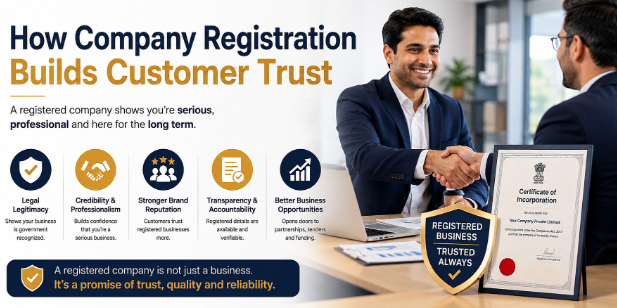
Imagine two vendors selling the exact same product. One operates as an unregistered proprietorship with no formal address, no GST invoice, and no way to verify who’s actually behind the business. The other is a Private Limited Company Registration, with a Certificate of Incorporation, a CIN number, GST registration, and a verifiable presence on the MCA portal.
This is the exact calculation customers, vendors, banks, and investors make every single day,often without even realising it. In a market flooded with fraud, fake sellers, and fly-by-night operators, company registration has quietly become one of the strongest trust signals a business can offer. It tells the world: we are real, we are accountable, and we follow the law.
For founders, this raises an important question,does formal registration actually change how customers perceive a brand, or is it just paperwork? The data, legal framework, and real business behaviour all point to the same answer: registration status directly shapes customer confidence, purchase decisions, and long-term loyalty.
What Is Company Registration?
Company registration is the legal process of incorporating a business entity under the Companies Act, 2013, through the Ministry of Corporate Affairs (MCA). Once registered, the business receives a Certificate of Incorporation (COI) and a unique Corporate Identification Number (CIN), making it a recognised legal entity separate from its owners.
This single step transforms a business from an informal setup into a legally accountable organisation,one that can enter contracts, own assets, sue and be sued, and be held responsible under Indian law.
Why Does Company Registration Matter for Customer Trust?
Company registration matters for customer trust because it proves the business is legally accountable, verifiable, and regulated,not an anonymous or informal seller.
Customers today are more cautious than ever. Before making a purchase, especially a high-value one, they check:
- Whether the company appears on the MCA portal
- Whether GST details match the invoice
- Whether the business has a registered office address
- Whether the brand has consistent legal documentation
A registered entity satisfies all these checks instantly. This is especially true for B2B transactions, government tenders, and partnerships with larger corporations, where vendor verification is mandatory before any deal is signed.
Did You Know? As per MCA data, India crossed over 1.6 million active registered companies in recent years, with private limited companies forming the largest share,reflecting how strongly Indian entrepreneurs associate formal registration with business credibility.
How Private Limited Company Registration Builds Deeper Trust
While all forms of company registration add credibility, private limited company registration offers the strongest trust signal among common business structures in India. Here’s why:
- Limited Liability Protection, Customers and vendors know that a Pvt Ltd company has a defined capital structure and legal accountability, reducing the risk of the business vanishing overnight.
- Mandatory Compliance,Private limited companies must file annual returns, financial statements, and audit reports with the Registrar of Companies (RoC), creating a public compliance trail.
- Separate Legal Identity, The company can be verified independently of its founders, which builds confidence among institutional buyers and investors.
- Professional Perception,A Pvt Ltd suffix in the business name is widely recognised as a mark of seriousness and long-term intent, not a side hustle.
- Investor and Funding Readiness,Venture capital and angel investors almost exclusively fund private limited companies, which indirectly boosts customer trust as well, since funded companies appear more stable.
Registered vs Unregistered Business: A Trust Comparison
| Feature | Registered Company (Pvt Ltd) | Unregistered Business |
| Legal identity | Separate legal entity | No separate identity |
| Liability | Limited to shareholding | Unlimited personal liability |
| MCA verification | Publicly verifiable (CIN) | Not verifiable |
| GST invoicing | Mandatory, standardised | Often inconsistent or absent |
| Investor funding | Eligible | Generally not eligible |
| Vendor/B2B trust | High | Low to moderate |
| Compliance visibility | Public RoC filings | None |
| Brand perception | Established, credible | Informal, higher perceived risk |
Legal and Financial Trust Signals Created by Registration
Company registration doesn’t just create a legal shield,it generates ongoing trust markers that customers and partners can independently verify:
- CIN Number,Publicly searchable on the MCA portal
- PAN and TAN,Issued in the company’s name, enabling formal tax compliance
- GST Registration,Enables GST-compliant invoicing, which B2B customers require
- Audited Financial Statements,Filed annually, visible to the public
- Registered Office Address,A verifiable physical presence
- Statutory Compliance History,Builds a track record over time
These signals matter most during high-value transactions, government contracts, franchise agreements, and partnerships,situations where trust cannot be based on word of mouth alone.
Common Mistakes Businesses Make
- Delaying registration while already operating and invoicing customers
- Using a proprietorship name that sounds like a private limited company (misleading customers)
- Ignoring post-registration compliance, which erodes the very trust registration created
- Failing to update the registered office address on MCA records
- Not linking GST registration properly with the company’s PAN
Risks of Staying Unregistered
- Loss of high-value and B2B customers who require verified vendors
- Ineligibility for government tenders and corporate empanelment
- No access to institutional funding
- Personal liability for business debts and disputes
- Lower trust in online marketplaces and payment gateway approvals
Case Study
A Chennai-based D2C skincare brand operated for two years as a sole proprietorship. Despite good products, it struggled to get listed with larger retail chains and payment aggregators, who required a registered entity for onboarding. After completing private limited company registration, the brand secured GST-compliant invoicing, passed vendor verification with three national retail chains within four months, and saw a 32% increase in B2B order value within the first two quarters,directly attributed to the credibility that formal registration provided.
Documents Required for Company Registration
| Document | Purpose |
| PAN Card of directors | Identity proof |
| Aadhaar Card / Passport | Address proof |
| Passport-size photographs | Identity verification |
| Registered office proof | Utility bill/rent agreement |
| NOC from property owner | Address confirmation |
| Digital Signature Certificate (DSC) | For filing forms |
Process, Fees, and Timeline
- Obtain Digital Signature Certificate (DSC)
- Apply for Director Identification Number (DIN)
- Reserve company name via RUN/SPICe+ Part A
- File incorporation forms (SPICe+ Part B) with MoA and AoA
- Receive Certificate of Incorporation, PAN, and TAN
Time Taken: Typically 7–10 working days, subject to document accuracy and MCA processing.
Fees: Government fees vary based on authorised capital; professional fees depend on the service provider. Zolvit offers transparent, upfront pricing with no hidden charges.
Compliance Checklist After Registration
- Open a company bank account
- Apply for GST registration
- Appoint a statutory auditor within 30 days
- Issue share certificates to shareholders
- File commencement of business declaration
- Maintain statutory registers
Conclusion
In today’s environment, customers don’t just buy products,they buy confidence. Company registration, and particularly private limited company registration, gives businesses the legal standing, transparency, and accountability that modern customers, vendors, and investors actively look for before engaging. Beyond compliance, registration is a strategic trust-building tool that opens doors to B2B deals, funding, and long-term brand credibility. Staying unregistered may seem simpler in the short term, but it quietly limits growth and increases legal risk. For any founder serious about scaling, consulting legal experts before choosing a business structure is a smart first step.
Why Choose Zolvit
- Expert lawyers and company secretaries guiding every step
- CA support for tax and compliance alignment
- Fast processing with minimal back-and-forth
- Affordable, transparent pricing with no hidden costs
- End-to-end compliance support, not just registration
- Dedicated support from application to certificate delivery
Get your private limited company registration done with Zolvit’s legal experts today,book a free consultation and let our team handle the paperwork while you focus on your customers.
FAQs
1. Can an unregistered business still gain customer trust?
YES, to a limited extent. Small, local, or referral-based businesses may build trust informally. However, for B2B deals, high-value purchases, or online marketplaces, customers increasingly expect verified company registration before transacting confidently.
2. Should every startup opt for private limited company registration?
YES, for most growth-focused startups. Private limited company registration offers limited liability, funding eligibility, and stronger credibility, making it the preferred structure for startups planning to scale, raise investment, or work with corporate clients.
3. What is the minimum requirement for private limited company registration?
A private limited company requires a minimum of two directors, two shareholders (can be the same individuals), a registered office address, and no minimum capital requirement under current Companies Act provisions.
4. Shall a company update its registered office details if it moves?
YES. Any change in registered office must be reported to the RoC within prescribed timelines. Outdated address records reduce transparency and can weaken the trust signal that registration is meant to provide to customers.
5. Does GST registration matter as much as company registration for trust?
YES, alongside company registration. GST registration enables compliant invoicing, which B2B customers and larger businesses often require before onboarding a vendor, making both registrations complementary trust indicators.
