

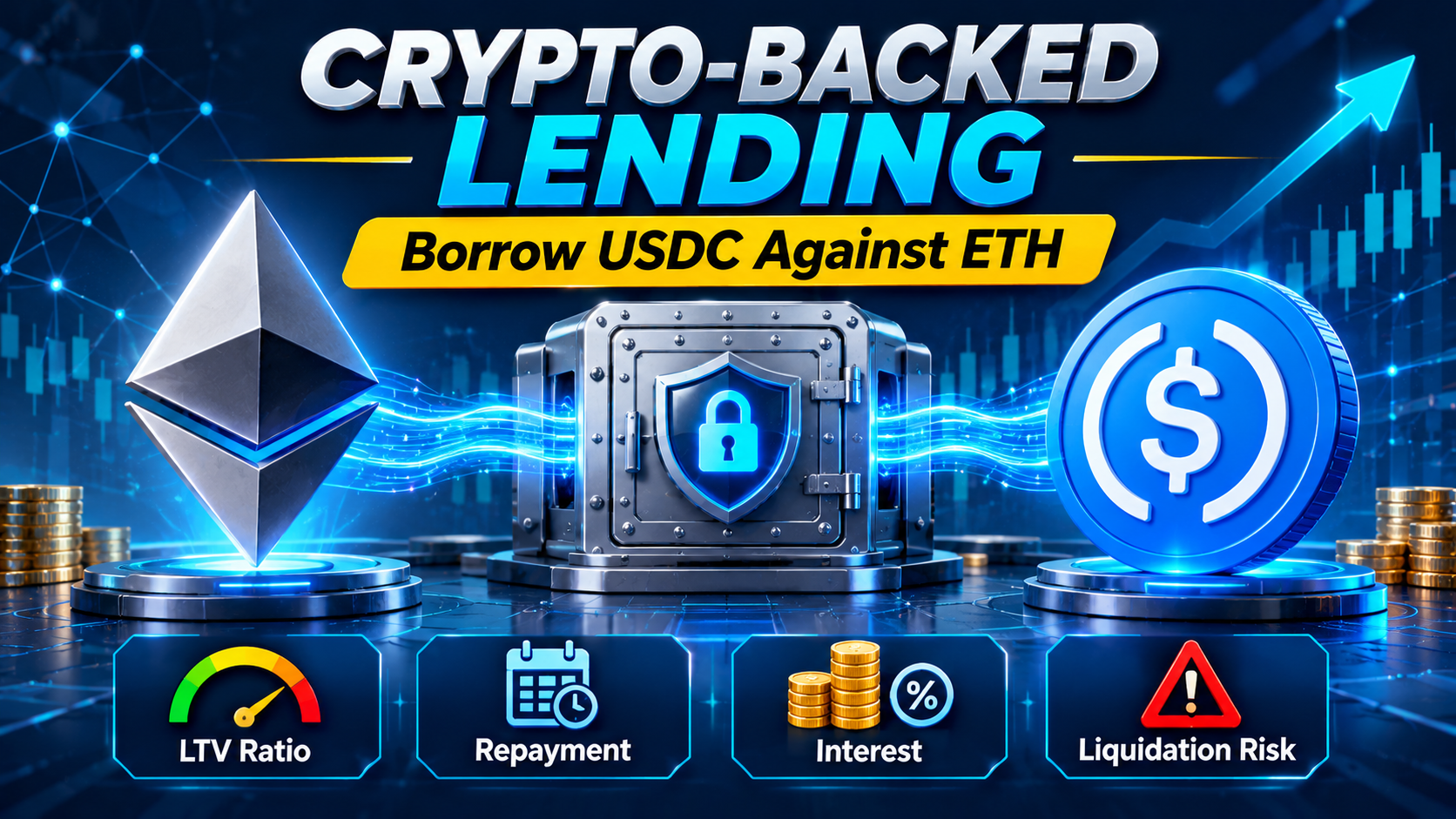
Cryptocurrency investors often face a difficult decision when they need cash: sell some of their digital assets or find another way to access liquidity. For long-term Ethereum holders, selling ETH can mean giving up potential future gains and changing an investment strategy they have spent considerable time building. Crypto-backed lending offers another option by allowing users to borrow stablecoins against their cryptocurrency holdings.
With crypto-backed credit facilities, borrowers can use their ETH as collateral and receive USDC without immediately selling their assets. This approach can provide access to funds for personal expenses, business activities, or other financial needs while maintaining exposure to Ethereum. However, understanding collateral requirements, borrowing costs, repayment conditions, and liquidation risks is essential before using any lending platform.
What Is Crypto-Backed Lending?
Crypto-backed lending is a financing arrangement in which borrowers deposit cryptocurrency as collateral to obtain a loan or credit facility in another digital asset. Instead of selling their ETH to obtain liquidity, they temporarily secure their borrowing against its market value.
For example, someone holding 10 ETH may want access to USDC without converting their entire Ethereum position into stablecoins. Through a crypto-backed lending service, they can deposit supported ETH as collateral and receive a borrowing limit based on the value of their holdings and the platform’s loan-to-value requirements.
USDC is a stablecoin designed to maintain a value close to one US dollar. Borrowing USDC can therefore provide relatively predictable spending power compared with borrowing another volatile cryptocurrency.
The borrower retains economic exposure to ETH, but the deposited collateral remains subject to the lending agreement. It may be locked in a smart contract or otherwise restricted until the outstanding obligations are settled.
How Does Borrowing USDC Against ETH Work?
The process generally involves depositing collateral, receiving an approved credit limit, accessing borrowed USDC, and repaying the outstanding balance.
Although individual platforms have different procedures, the typical process includes several steps:
- Connect a compatible wallet: The borrower connects a supported cryptocurrency wallet to the lending platform.
- Choose collateral: The user selects an eligible asset, such as ETH, and specifies the amount to provide as collateral.
- Review borrowing terms: The platform evaluates the collateral value and determines the available credit based on its LTV limits, fees, and other conditions.
- Open the credit facility: The borrower reviews and authorizes the required blockchain transactions.
- Access USDC: Once the credit facility is active, the borrower can withdraw or use USDC within the approved limit.
- Repay the balance: The borrower returns the borrowed USDC and any applicable interest or fees according to the agreement.
Some lending services offer a traditional loan with a predetermined borrowing amount. Others provide revolving credit facilities, where users can access funds when needed and restore available credit by repaying the principal.
Understanding Collateral Requirements and Loan-to-Value Ratios
Collateral is the foundation of crypto-backed lending. It protects the lender if a borrower cannot meet repayment obligations.
One of the most important factors in determining borrowing capacity is the loan-to-value ratio, commonly known as LTV. It compares the outstanding borrowing amount with the current market value of the collateral.
For example, suppose a borrower deposits ETH worth $10,000 and receives a credit limit of $4,000. If the borrower uses the entire amount, the initial LTV is 40%.
However, if the value of ETH declines to $7,000 while the outstanding debt remains $4,000, the LTV increases to approximately 57.1%.
This demonstrates why collateral values must be monitored throughout the borrowing period.
Lending platforms establish their own collateral requirements and risk thresholds. These may include:
- Minimum collateral amounts.
- Maximum initial LTV ratios.
- Minimum collateralization requirements.
- Spending restrictions when LTV increases.
- Liquidation thresholds for protecting the lending system.
Borrowers should avoid using the maximum available credit simply because a platform makes it accessible. Maintaining additional collateral protection can help reduce the risk of liquidation during periods of market volatility.
Crypto Line of Credit vs Loan: Understanding the Difference
Although crypto-backed loans and credit lines both provide liquidity against digital assets, their structures can be different.
A traditional crypto loan generally provides a specific amount of funds at the beginning of the agreement. Interest and repayment obligations then follow the loan’s terms.
A crypto line of credit, on the other hand, provides access to an approved borrowing limit. The borrower can use only the amount required rather than automatically treating the entire credit limit as outstanding debt.
For example, imagine an investor receives a credit limit of 10,000 USDC but initially needs only 2,500 USDC. With a revolving credit structure, the borrower can access the smaller amount while leaving the remaining capacity unused.
This distinction can make credit lines useful for people with changing or recurring liquidity requirements.
Some platforms also restore available credit when borrowers repay the principal. This means the same credit facility can potentially be used again without opening an entirely new borrowing arrangement, subject to the platform’s current conditions.
XQ Finance is an example of a wallet-based platform designed around ETH-backed USDC credit lines on Base. Its model separates the approved credit limit from the amount actually used, allowing borrowers to access USDC as needed. Users researching the differences between these borrowing structures can explore the crypto line of credit vs loan explanation for additional details.
How Interest Is Calculated on Crypto-Backed Credit
Interest is one of the most important costs to understand before borrowing against cryptocurrency. Different lending platforms use different interest models, so borrowers should review the applicable APR, calculation method, and repayment schedule.
In many credit-line arrangements, interest is calculated on the amount actually borrowed rather than the entire approved credit limit.
A simplified interest calculation is:
Interest = Borrowed Amount × Annual Interest Rate × (Days Borrowed / 365)
For example, if someone borrows 3,000 USDC at an annual interest rate of 12% for 30 days, the estimated simple interest would be:
3,000 × 0.12 × (30 / 365) = approximately 29.59 USDC.
This is an illustrative calculation. Actual charges can differ depending on compounding rules, payment timing, fees, and the lender’s agreement.
Some services also provide promotional borrowing conditions or grace periods. XQ Finance, for example, describes a 14-day grace period under which the used amount does not accrue interest if it is fully repaid within the applicable period.
However, borrowers should understand that a 0% interest period does not necessarily mean borrowing is completely free. Origination fees, blockchain transaction costs, and other applicable charges may still apply. Any balance that remains after the grace period may also become subject to the standard interest terms.
Repayment Terms and Managing Outstanding Debt
Repayment conditions determine how borrowers return the funds and recover access to their collateral.
Traditional crypto loans may have fixed maturity dates, scheduled payments, or specific repayment requirements. Revolving credit facilities can offer greater flexibility, but borrowers must still meet their contractual obligations.
Before opening a credit facility, users should understand:
- Whether partial repayments are permitted.
- When interest begins accumulating.
- Whether there are minimum payment requirements.
- How repayments are allocated between fees, interest, and principal.
- Whether repaying principal restores available credit.
- What happens if a payment is delayed.
- When collateral can be withdrawn.
In a revolving credit facility, repayments may first cover penalties, interest, and outstanding fees before reducing the principal. Only the portion applied to principal may restore available borrowing capacity.
For example, if a user has borrowed 4,000 USDC and makes a payment of 1,000 USDC, the full payment may not necessarily reduce the principal by 1,000 USDC if additional charges are outstanding.
Keeping track of payment deadlines and outstanding balances helps borrowers avoid unnecessary costs and maintain control over their positions.
Blockchain Transaction Fees and Network Costs
Crypto-backed lending operates through blockchain networks, meaning users may need to pay transaction fees when opening credit facilities, depositing collateral, accessing funds, or making repayments.
These fees are commonly called gas fees. They compensate the network for processing and validating transactions.
The actual cost depends on several factors, including network activity, transaction complexity, and the blockchain being used.
Ethereum mainnet can experience higher transaction costs during periods of heavy activity. Layer-2 networks such as Base are designed to offer lower-cost transactions while benefiting from Ethereum’s underlying security architecture.
When evaluating a lending platform, users should consider the complete transaction process rather than focusing only on the advertised interest rate.
Potential expenses include:
- Collateral deposit transaction fees.
- Smart contract interaction costs.
- Borrowing and repayment transaction fees.
- Network bridging costs when moving assets between blockchains.
- Origination and service fees.
- Potential liquidation-related charges.
Choosing a suitable network and understanding the transaction route can help users estimate the total cost of borrowing more accurately.
Key Risks of Borrowing Against Ethereum
Crypto-backed lending provides access to liquidity without requiring an immediate sale of ETH, but it also introduces financial and technical risks.
1. ETH Price Volatility
The value of Ethereum can change significantly over short periods. If ETH prices decline, the collateral may become insufficient relative to the outstanding debt. This can increase the LTV ratio and potentially trigger restrictions or liquidation.
2. Liquidation Risk
If collateral value falls below a platform’s required threshold, the lending protocol may automatically sell some or all of the deposited assets to recover the outstanding amount. Borrowers should understand liquidation rules before depositing collateral.
3. Interest and Repayment Risk
Borrowing costs can increase when repayment is delayed or when variable interest rates change. Users should have a realistic repayment strategy instead of relying entirely on future cryptocurrency price increases.
4. Smart Contract Vulnerabilities
Blockchain-based lending depends on smart contracts to manage collateral, borrowing, and repayments. Bugs, security weaknesses, or unexpected contract behavior can create financial losses.
5. Liquidity and Network Risks
A platform may have limited USDC liquidity, preventing borrowers from accessing their full available credit. Network congestion, outages, or oracle disruptions can also delay certain operations.
6. Wallet Security
Non-custodial wallets give users control over their private keys, but they also make wallet security their responsibility. Phishing attacks, compromised devices, and unauthorized transaction approvals can result in permanent asset losses.
Understanding these risks is essential for making informed borrowing decisions.
Choosing a Suitable Crypto-Backed Lending Platform
Not every lending platform offers the same features, costs, or security arrangements. Users should compare providers carefully before committing their cryptocurrency as collateral.
Important factors include collateral requirements, supported networks, interest rates, repayment flexibility, liquidation policies, and transaction fees.
Transparency is particularly important. A reliable lending service should explain how credit limits are calculated, when interest starts accruing, how collateral is valued, and what happens when borrowers fail to meet repayment conditions.
It is also useful to understand whether the service uses custodial or non-custodial arrangements and whether users can independently review relevant smart contract information.
Platforms offering reusable credit facilities may be suitable for users who need occasional or recurring access to liquidity. However, convenience should never replace a careful review of borrowing terms and risk controls.
Final Thoughts
Crypto-backed lending gives Ethereum holders another way to access liquidity without immediately selling their digital assets. By using ETH as collateral, borrowers can obtain USDC for different financial needs while maintaining exposure to their cryptocurrency holdings.
However, the benefits depend on understanding how collateral requirements, LTV ratios, interest charges, repayment terms, and blockchain fees work together. A lower advertised interest rate does not eliminate market volatility, liquidation exposure, or smart contract risks.
Before using any crypto-backed lending service, borrowers should review the complete terms, calculate their potential costs, and maintain a realistic repayment strategy. With careful planning and a clear understanding of the risks, ETH-backed credit facilities can offer an additional liquidity option within the broader digital asset ecosystem.
