


Empty leg private jet flights in Florida constitute a significant operational phenomenon within one of the most active private aviation markets in the United States. These flights arise from the need to reposition aircraft between charter assignments and are frequently offered to clients at reduced rates. In Florida, where demand for private aviation is consistently high, the prevalence of empty leg flights reflects both the scale of charter activity and the structural characteristics of on-demand air travel.
Operational Context and Market Environment
The frequency of empty leg flights in Florida is closely linked to the state’s role as a major hub for both business and leisure aviation. Cities such as Miami, Fort Lauderdale, Palm Beach, and Orlando generate substantial volumes of one-way charter traffic. This creates a continuous need for aircraft repositioning, resulting in a steady supply of empty leg opportunities.
Florida’s geographic position further contributes to this dynamic. As a gateway to the Caribbean and Latin America, the state supports complex international itineraries that often require aircraft to relocate between destinations without passengers. These operational requirements increase the frequency and diversity of empty leg routes.
Pricing Structures and Cost Efficiency
Empty leg flights are typically offered at significantly discounted rates compared to standard charter services. Pricing reductions commonly range from 30% to 70%, reflecting the marginal cost of operating a flight that is already scheduled.
The final cost of an empty leg flight depends on several variables, including aircraft category, flight distance, fuel costs, and airport fees. Additionally, pricing is influenced by demand conditions and the timing of booking. Last-minute availability often results in deeper discounts, as operators seek to maximize revenue from otherwise non-revenue segments.
This pricing model provides a cost-efficient alternative for clients while enabling operators to improve financial performance through enhanced asset utilization.
Availability Patterns and Seasonal Variability
The availability of empty leg flights in Florida is characterized by both abundance and variability. Given the high volume of private jet operations, a wide range of routes and aircraft types are regularly available. However, availability is inherently dependent on existing charter bookings, making it unpredictable.
Seasonal trends play a significant role in shaping availability. During peak travel periods – particularly in winter months – Florida experiences a surge in inbound private jet traffic. This often results in an increased number of outbound empty legs, creating favorable conditions for clients seeking discounted travel options.
Digital charter platforms have enhanced visibility into these patterns by providing real-time listings and notifications, allowing clients to identify opportunities more efficiently.
Advantages for Clients
Empty leg flights offer several advantages for clients, most notably in terms of cost savings. They provide access to private jet travel at a reduced price point while preserving the core benefits of private aviation, including flexibility, speed, and comfort.
In Florida, where multiple executive airports are available, clients can also benefit from convenient departure and arrival locations. The ability to avoid congested commercial terminals and access smaller airports enhances the overall travel experience.
Empty leg flights are particularly attractive to leisure travelers and individuals with flexible schedules, as they allow for spontaneous and cost-effective travel.
Limitations and Operational Constraints
Despite their benefits, empty leg flights are subject to several limitations. The most significant constraint is the lack of flexibility in scheduling and routing. These flights are predetermined by the operational requirements of the aircraft, requiring clients to adapt to fixed itineraries.
Availability is also uncertain, as empty leg opportunities depend on existing charter schedules. Changes to the primary booking may result in cancellation or modification of the empty leg flight.
Additionally, empty leg flights are typically one-way, necessitating separate arrangements for return travel. This limitation reduces their suitability for structured or time-sensitive itineraries.
Role in Fleet Optimization and Efficiency
From an operator’s perspective, empty leg flights play a crucial role in optimizing fleet utilization. By monetizing repositioning segments, companies can reduce the financial impact of non-revenue flights and improve overall operational efficiency.
Advanced scheduling systems and data analytics enable operators to identify and market empty leg opportunities more effectively. These technologies facilitate better alignment between supply and demand, increasing the likelihood of converting empty legs into revenue-generating flights.
Efficient management of these flights contributes to improved profitability and supports more sustainable use of aviation resources.
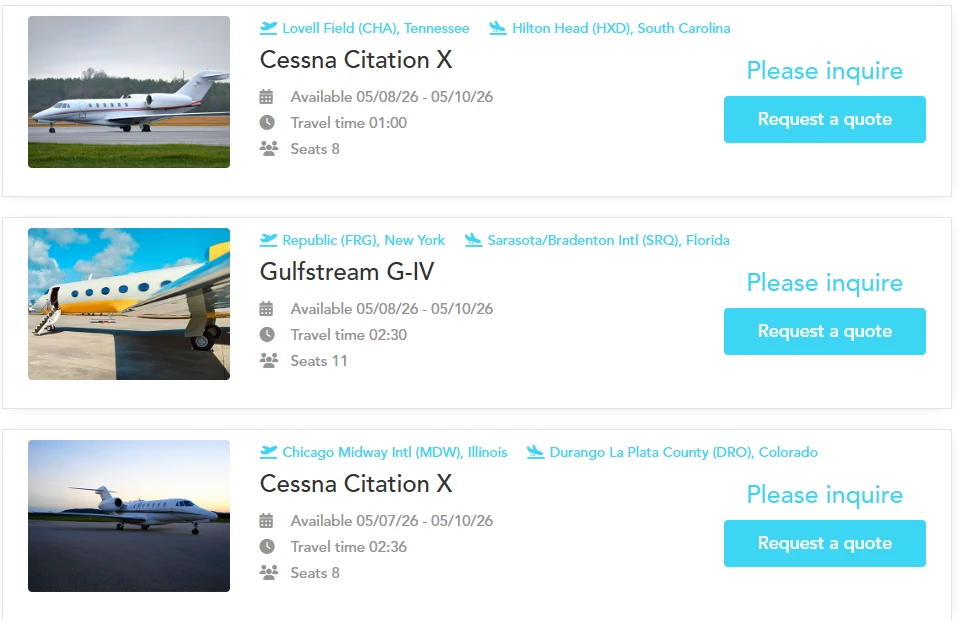
Technological Integration and Market Development
The integration of digital technologies has transformed the empty leg flight market in Florida. Online platforms and mobile applications provide real-time access to available flights, enabling clients to compare options and make informed decisions.
These platforms aggregate offerings from multiple operators, increasing transparency and expanding the range of available choices. Data analytics further enhances pricing accuracy and availability forecasting.
As digitalization continues to advance, the empty leg market is expected to become more structured and accessible, benefiting both operators and clients.
Environmental Considerations
Empty leg flights have implications for environmental efficiency. While these flights would occur regardless of passenger occupancy, filling them with passengers improves resource utilization and reduces the relative environmental impact per traveler.
However, the broader environmental impact of private aviation remains a subject of ongoing concern. Operators in Florida are increasingly adopting sustainability measures, including sustainable aviation fuel (SAF) and carbon offset programs, to mitigate emissions.
Future Outlook
The role of empty leg flights in Florida’s private aviation sector is expected to expand as demand continues to grow and technological capabilities improve. Enhanced data-driven scheduling and digital platforms will likely increase the efficiency and visibility of these flights.
At the same time, greater consumer awareness of cost-saving opportunities is expected to drive demand. As competition intensifies, operators may further refine pricing strategies and expand access to empty leg offerings.
Empty leg private jet flights in Florida illustrate the intersection of operational necessity and economic opportunity. By converting repositioning flights into accessible travel options, the industry enhances efficiency while offering clients a cost-effective entry point into private aviation