

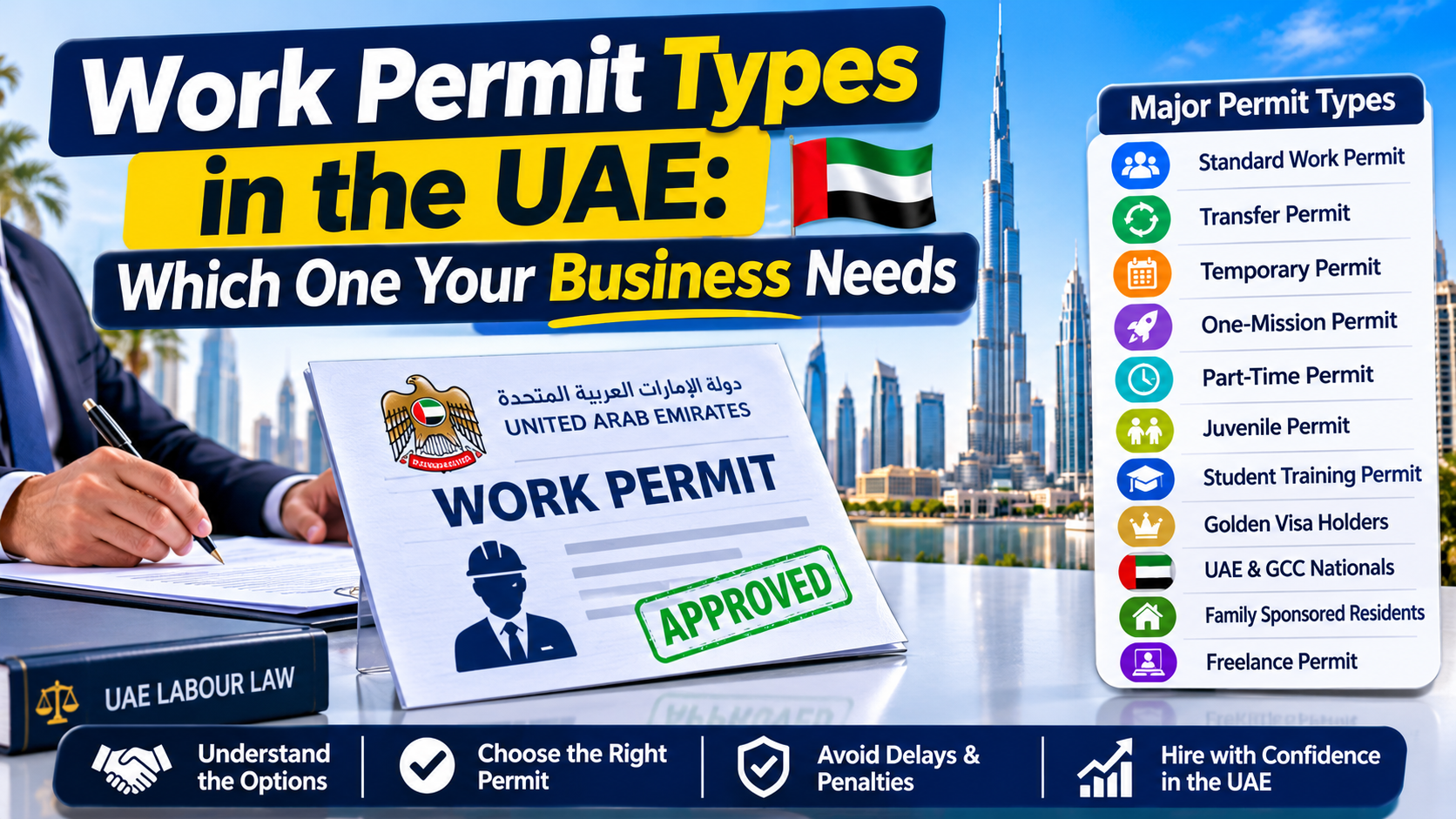
For founders preparing to hire in the UAE, the term work permit can be misleading. It sounds like a single document, but it covers a range of permit types, each tied to a particular sponsor, role and working arrangement. Choosing the wrong one can delay a hire by weeks or lead to a rejected application, so it pays to understand the options before making an offer.
Work Permit Versus Residence Visa
A work permit authorises a person to work for a specific employer, while a residence visa authorises them to live in the UAE. For most employees the two are processed together, with the Emirates ID following the residence visa as a separate step, but they remain distinct approvals. An engineer already in the country on a visit visa, for example, needs both the employment approval and residency in place before starting work. A practical guide to work permit types in the UAE explains how these approvals fit together.
Why the Sponsor Decides the Route
The employer’s licensing authority determines which system applies. Private sector employment is governed by Federal Decree-Law No. 33 of 2021, and for mainland employers the Ministry of Human Resources and Emiratisation (MOHRE) issues work permits and registers contracts. Free zone companies generally sponsor staff through their own free zone authority instead, under that zone’s residency process. Two companies hiring for the same role, one on the mainland and one in a free zone, will therefore follow different approval routes.
The MOHRE Permit Categories
For establishments registered with MOHRE, Article 6 of Cabinet Resolution No. 1 of 2022 sets out the permit types, and the government portal lists twelve, with MOHRE adding further categories since. The most commonly used are the standard permit for recruiting a worker from outside the UAE and the transfer permit for hiring someone moving from another employer within the country. A temporary permit covers project-based or fixed-period work, while a one-mission permit allows a company to bring in a worker from abroad for a specific short-term assignment.
Flexible arrangements have their own permits. A part-time permit allows a worker to be employed on reduced hours or days, and to work for more than one employer with the ministry’s approval. A juvenile permit covers workers aged 15 to 18, subject to the law’s restrictions on hours and types of work, and there are separate permits for student training, for Golden Visa holders, for UAE and GCC nationals and for residents sponsored by their families. A freelance permit is available for self-employed individuals working without a sponsoring employer.
Owners and Investors
Business owners and shareholders do not usually need a standard employment permit. They typically obtain residency through their shareholding as investors or partners, while staff hired later follow the employment route.
Choosing the Right Permit
A simple sequence prevents most errors. The first step is to confirm the company’s licensing jurisdiction, since mainland or free zone status decides the route, and to check that the licensed activity matches the role. Next, the founder defines the worker’s status: employee, owner, short-term contractor or part-time hire, inside or outside the UAE. The company then checks its visa allocation against planned headcount. Finally, documents are prepared, including the passport, photograph and any required qualifications. Foreign certificates usually need notarisation, legalisation by the UAE embassy and attestation by the UAE Ministry of Foreign Affairs, and incomplete attestation is a common reason applications are returned.
Costs and Compliance Risks
Permit costs typically include government fees, the medical fitness test, the Emirates ID and health insurance, and most recur at renewal. The main risks are applying under the wrong permit type, submitting incomplete documents and allowing someone to start work before approval. An employee who begins work on a visit visa exposes the employer to penalties and can cause the worker’s later application to be refused.
Conclusion
Work permit types in the UAE come down to who sponsors the worker, where the company is licensed and how the role is structured. Mainland employers follow MOHRE’s permit categories, free zone companies follow their authority’s process and owners obtain residency through their shareholding. Founders setting up in free zones such as Meydan Free Zone should map their planned hires against their visa allocation before making the first offer.
