
Introduction
When working on your own, is there one Company registration decision that you have most likely been forced to make at some point: register as a One Person Company (OPC) or directly register as a Private Limited Company having a nominal second member in order to comply with the two-person criteria? It seems like a small technical detail, but it is not – it determines how you will be taxed, how many forms you need to file annually, and whether or not you would be able to attract investors or co-founders without switching entities in the future.
There is a reason for confusion here. Both of those are entities registered with MCA, both are governed by the Companies Act, 2013, and both offer a possibility of limited liability protection. However, OPC was specifically designed for single entrepreneurs, being more flexible and having mandatory nomination clauses, while Private Limited Company is set up to expand and get investment capital right away.
Once you make a wrong decision, correcting it is not going to come cheap – changing the entity from OPC to Private Limited Company will require new MoA or AoA, additional directors, ROC forms, etc.
What Is Company Registration (Private Limited Company)?
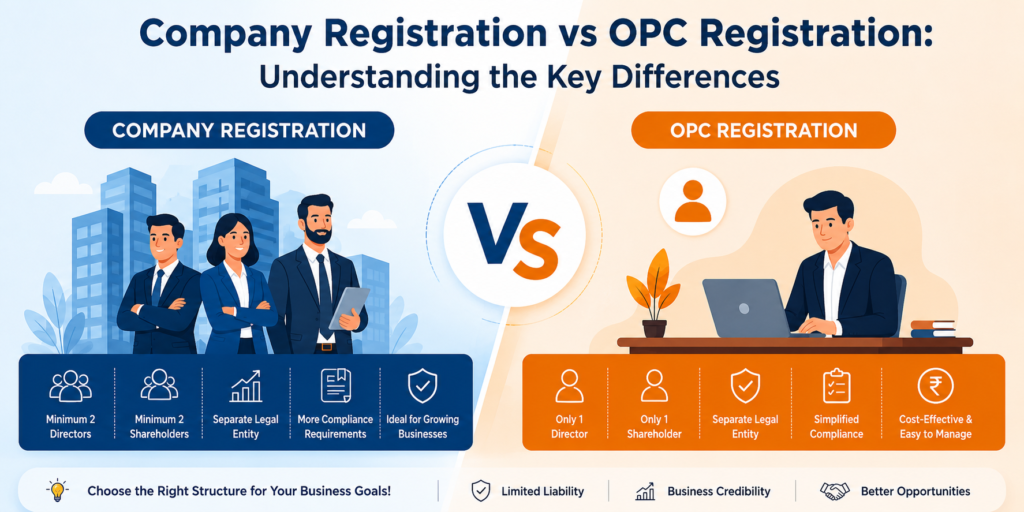
A Private Limited Company Registration is a business entity incorporated under the Companies Act, 2013, registered with the MCA, requiring a minimum of two shareholders and two directors, with a separate legal identity, limited liability, and the ability to raise capital by issuing shares.
Key features of a Private Limited Company:
- Requires minimum 2 shareholders and 2 directors (can be different people)
- Can issue equity shares, preference shares, and ESOPs
- No restriction on number of members up to 200
- Well suited for external fundraising, VC, PE, angel investment
- Mandatory statutory audit regardless of turnover
- Higher compliance obligations, board meetings, ROC filings, secretarial records
Did You Know? A Private Limited Company can have up to 200 shareholders under the Companies Act, 2013, making it the structure of choice for businesses planning employee stock ownership plans (ESOPs) or multiple funding rounds.
What Is an OPC (One Person Company)?
What is an OPC? A One Person Company (OPC) is a corporate structure introduced under Section 2(62) of the Companies Act, 2013, that allows a single individual to incorporate a company with limited liability, a separate legal identity, and a mandatory nominee, without needing a co-founder.
An OPC gives a solo entrepreneur most of the credibility and legal protection of a Private Limited Company, a distinct legal identity, limited liability, and eligibility for business loans, with a meaningfully lighter compliance burden.
Eligibility criteria to register an OPC:
- Must be a natural person (not a company or LLP)
- Must be an Indian citizen, resident or NRI, following the Companies (Incorporation) Second Amendment Rules, 2021
- Must have stayed in India for at least 120 days in the preceding financial year to qualify as “resident” for this purpose
- Cannot be a member of more than one OPC at a time
- Must appoint a nominee (also an Indian citizen) at the time of incorporation via Form INC-3
Key features of an OPC:
- Single member acts as both shareholder and director
- Separate legal identity, creditors can sue the OPC, not the individual personally
- Mandatory nominee for succession in case of death or incapacity
- Company name must end with “(OPC) Private Limited”
- Cannot raise funds by issuing shares to outside investors, since there is only one member by law
- No mandatory conversion any more, regardless of turnover or capital, following the 2021 amendment
Quote: An OPC was designed to let a solo founder look and operate like a company, right up until the day they need a co-founder or an investor, at which point conversion becomes unavoidable.
Company Registration vs OPC Registration: Key Differences
| Feature | Private Limited Company | OPC (One Person Company) |
| Governing Section | Companies Act, 2013 (general provisions) | Section 2(62), Companies Act, 2013 |
| Minimum Members | 2 shareholders, 2 directors | 1 member (also sole director) |
| Maximum Members | Up to 200 | 1 (structurally capped) |
| Nominee Requirement | Not applicable | Mandatory (Form INC-3) |
| Can Issue Shares to Investors | Yes | No |
| Fundraising (VC or PE) | Well suited | Not suited, must convert first |
| Eligibility | Any individual or entity as per Companies Act | Only a natural person, Indian citizen (resident or NRI) |
| Statutory Audit | Mandatory, regardless of turnover | Mandatory, regardless of turnover |
| Board Meetings | Minimum prescribed frequency | Relaxed requirements, at least one per half-year |
| Cash Flow Statement | Mandatory | Exempted |
| Annual Compliance Cost | ₹15,000 – ₹40,000+ | Lower, fewer filings than Pvt Ltd |
| Registration Cost (all-inclusive) | ₹7,000 – ₹25,000 | ₹6,000 – ₹20,000 |
| Best Suited For | Multi-founder startups planning to raise funding | Solo entrepreneurs wanting corporate identity without a co-founder |
The single biggest difference isn’t compliance cost, it’s the ability to raise equity. An OPC structurally cannot admit a second shareholder without converting into a Private Limited Company first.
Documents Required for Company vs OPC Registration
Common documents required (both structures):
- PAN and Aadhaar of the director(s) or member
- Address proof (bank statement or utility bill, not older than 2 months)
- Passport-size photograph
- Registered office proof (rent agreement or sale deed + utility bill + NOC)
- Digital Signature Certificate (DSC)
Additional documents for a Private Limited Company:
- Memorandum of Association (MoA) and Articles of Association (AoA) for two or more subscribers
- Declaration by subscribers and first directors (INC-9)
Additional documents for an OPC:
- Nominee’s PAN, Aadhaar, and consent (Form INC-3), this is unique to OPC and cannot be added after incorporation
- MoA and AoA reflecting single-member structure
Registration Process: Step-by-Step
How to Register a Private Limited Company
Step 1: Obtain DSC for all proposed directors
Step 2: Apply for Director Identification Number (DIN)
Step 3: Reserve the company name via SPICe+ Part A
Step 4: File SPICe+ Part B with MoA, AoA, and declarations
Step 5: Receive the Certificate of Incorporation with PAN and TAN
Step 6: File INC-20A (commencement of business) before starting operations
How to Register an OPC
Step 1: Obtain DSC for the sole member or director
Step 2: Choose and reserve a name ending in “(OPC) Private Limited” via SPICe+ Part A
Step 3: File SPICe+ Part B on the MCA V3 portal, along with Form INC-3 for nominee consent
Step 4: Receive the Certificate of Incorporation, PAN, and TAN, SPICe+ also covers GST, EPFO, and ESIC registration where applicable
Step 5: File INC-20A within 180 days of incorporation to commence business
Step 6: Open a current bank account in the OPC’s name
Time taken: Both structures typically take 7–15 working days, subject to clean documentation and name availability.
Cost Comparison: Company Registration vs OPC Registration Fees
| Cost Component | Private Limited Company | OPC |
| Government or MCA Fees | Nominal for small companies; scales with authorised capital | Reduced fee slabs for paid-up capital up to ₹50 lakh |
| Stamp Duty | ₹200 – ₹12,600, depending on state | Similar state-based stamp duty |
| DSC Charges | Per director (minimum 2) | Single DSC (only one director or member) |
| Professional Fees | ₹5,000 – ₹15,000 | ₹5,000 – ₹15,000 (plus 18% GST) |
| Total All-Inclusive Cost | ₹7,000 – ₹25,000 | ₹6,000 – ₹20,000 |
| Annual Compliance Cost | ₹15,000 – ₹40,000+ | Lower, fewer filings, no cash flow statement |
A commonly missed cost: professional fees for OPC registration attract 18% GST, so a quoted ₹10,000 professional fee effectively becomes ₹11,800. Always ask for a GST-inclusive quote before budgeting.
Compliance Requirements After Registration
Compliance Checklist, Private Limited Company:
- Appointment of statutory auditor (Form ADT-1) within 30 days
- Filing of commencement of business (INC-20A)
- Minimum number of board meetings per year (higher frequency than OPC)
- Annual filing of financial statements (AOC-4) and annual return (MGT-7 or MGT-7A)
- DIR-3 KYC for all directors
- Mandatory statutory audit
- Preparation of cash flow statement
Compliance Checklist, OPC:
- Annual filing of financial statements (AOC-4), by 27th September
- Annual return (MGT-7A), by 30th May
- Mandatory statutory audit regardless of turnover
- At least one board meeting per half-year, with a minimum gap of 90 days
- Exempted from preparing a cash flow statement
- Books of accounts and annual returns can be signed by the director alone, no Company Secretary signature required
Penalties: Late filing of AOC-4 or MGT-7A attracts an additional fee of ₹100 per day, with no upper cap, for both structures. Continued non-filing can eventually lead to strike-off under Section 248. OPCs and small companies benefit from reduced penalties, generally half the standard amount, under Section 446B.
OPC-to-Company Conversion: What Changed
Founders often assume an OPC must convert once it grows. That is no longer true.
Under the pre-2021 rules, an OPC was required to compulsorily convert into a Private Limited Company if paid-up capital crossed ₹50 lakh or average turnover over three consecutive years crossed ₹2 crore. The Companies (Incorporation) Second Amendment Rules, 2021 removed this mandatory trigger entirely.
What this means today:
- An OPC can operate indefinitely, regardless of how large its turnover or paid-up capital grows
- Conversion into a Private Limited Company is now entirely voluntary, filed via Form INC-6
- The earlier two-year lock-in before voluntary conversion was also removed, conversion can happen at any time after incorporation
- Conversion still requires increasing the number of directors and members to the statutory minimum for the target structure
Case Study: A solo SaaS founder in Bengaluru registered an OPC in 2022 to avoid finding a nominal co-founder. By 2025, the business had crossed ₹3 crore in annual turnover, a figure that would have forced conversion under the old rules. Because of the 2021 amendment, the founder continued operating as an OPC without any compulsory conversion, and only converted voluntarily in 2026 when a strategic investor wanted equity.
Which One Should You Choose?
Choose a Private Limited Company if:
- You have a co-founder or plan to bring one in soon
- You want to raise VC, angel, or PE funding
- You plan to issue ESOPs to early employees
- You expect to scale to multiple shareholders quickly
Choose an OPC if:
- You’re a solo entrepreneur with no immediate co-founder
- You want limited liability and corporate credibility without diluting ownership
- You want lower compliance costs than a full Private Limited Company
- You’re comfortable appointing a nominee for succession purposes
Common Mistakes to Avoid
- Registering a Private Limited Company with a nominal second shareholder just to meet the two-member rule, instead of choosing an OPC
- Forgetting to file Form INC-3 (nominee consent) at incorporation, it cannot be added later
- Assuming an OPC must convert once turnover crosses ₹2 crore, this rule was removed in 2021
- Missing the INC-20A commencement filing within 180 days, which blocks the OPC or company from legally starting business
- Choosing an OPC despite already having funding plans, leading to an avoidable conversion later
- Ignoring the 18% GST on professional fees while budgeting for OPC registration
Latest News: Regulatory Updates You Should Know (2025–2026)
- The Companies (Incorporation) Second Amendment Rules, 2021 remain the governing framework in 2026, mandatory OPC conversion thresholds (₹50 lakh paid-up capital, ₹2 crore turnover) continue to stay abolished, and NRIs remain eligible to incorporate an OPC.
- Most OPCs now qualify as “small companies” under Section 2(85) of the Companies Act, following the December 2025 expansion of small company thresholds to ₹10 crore paid-up capital and ₹100 crore turnover, unlocking reduced penalties and audit-related exemptions.
- Draft Companies (Incorporation) Amendment Rules, 2026 propose consolidating multiple incorporation-related MCA forms and simplifying KYC or consent documentation, which is expected to further streamline OPC and company incorporation once notified.
Because compliance thresholds and forms continue to evolve, always verify the current rules on the MCA portal or consult a professional before filing.
Conclusion
Choosing between Company Registration and OPC Registration comes down to one question: are you building this alone, or do you already know you’ll need co-founders and investors? An OPC gives a solo founder the credibility and legal protection of a corporate structure with a lighter compliance load, and, since 2021, no forced conversion as the business grows. A Private Limited Company is built from day one for multiple stakeholders, equity fundraising, and scale.
Whichever path you choose, make sure your nominee filings, statutory audits, and annual ROC compliance are handled correctly from the start, a wrong structure or a missed filing is far more expensive to fix later than to get right the first time.
Talk to Vakilsearch ‘s legal and compliance experts before you register, get it right the first time.
Why Choose Vakilsearch
- Expert lawyers and CAs experienced in both OPC and Private Limited Company registration
- Company Secretary support for ongoing ROC and MCA compliance
- Fast processing with minimal back-and-forth
- Affordable, transparent pricing, no hidden charges
- End-to-end compliance, from incorporation to annual filings and future conversion
- Dedicated support throughout your business lifecycle
Ready to register your business the right way? Get expert consultation, fast filing, and complete compliance support with Vakilsearch, talk to our experts today.
Key Takeaways
- A Private Limited Company needs a minimum of two shareholders and directors; an OPC needs only one.
- An OPC is designed for solo founders, offering limited liability and corporate identity without a co-founder.
- Only a Private Limited Company can issue shares to outside investors, an OPC structurally cannot.
- Since the 2021 amendment, OPCs are no longer forced to convert on crossing turnover or capital thresholds.
- OPCs enjoy lighter compliance, no cash flow statement, relaxed board meeting frequency, and reduced penalties as small companies.
- Converting an OPC to a Private Limited Company is voluntary and possible any time, via Form INC-6.
FAQs
1. Can an NRI register a One Person Company in India?
YES. Following the Companies (Incorporation) Second Amendment Rules, 2021, both resident Indian citizens and NRIs are eligible to incorporate an OPC, provided they meet the 120-day residency condition where applicable.
2. Must an OPC convert into a Private Limited Company once turnover crosses ₹2 crore? NO. The mandatory conversion requirement based on turnover or paid-up capital thresholds was removed by the Companies (Incorporation) Second Amendment Rules, 2021. An OPC can continue operating indefinitely regardless of financial size.
3. Can an OPC issue shares to outside investors?
NO. An OPC is structurally limited to one member by law, so it cannot issue shares to external investors. To raise equity funding, the OPC must first convert into a Private Limited Company.
4. Is a nominee mandatory for OPC registration?
YES. Every OPC must appoint a nominee at the time of incorporation via Form INC-3. The nominee must be an Indian citizen and provide consent, ensuring business continuity if the sole member becomes incapacitated or passes away.
5. Is statutory audit mandatory for an OPC?
YES. Unlike an LLP, an OPC must undergo mandatory statutory audit regardless of its turnover, since it is legally classified as a private company under the Companies Act, 2013.
6. Can one person register multiple OPCs?
NO. An individual can be a member of only one OPC at a time. To start a second business with a similar structure, the person would need to consider a Private Limited Company or LLP instead.
7. Does an OPC need to prepare a cash flow statement?
NO. An OPC is specifically exempted from preparing a cash flow statement as part of its annual financial statements, unlike a Private Limited Company, which must include one.
8. Can a Private Limited Company convert into an OPC?
YES, but only if its paid-up share capital and average annual turnover fall within OPC eligibility limits at the time of conversion, and the conversion is approved by the Registrar via the prescribed form.