

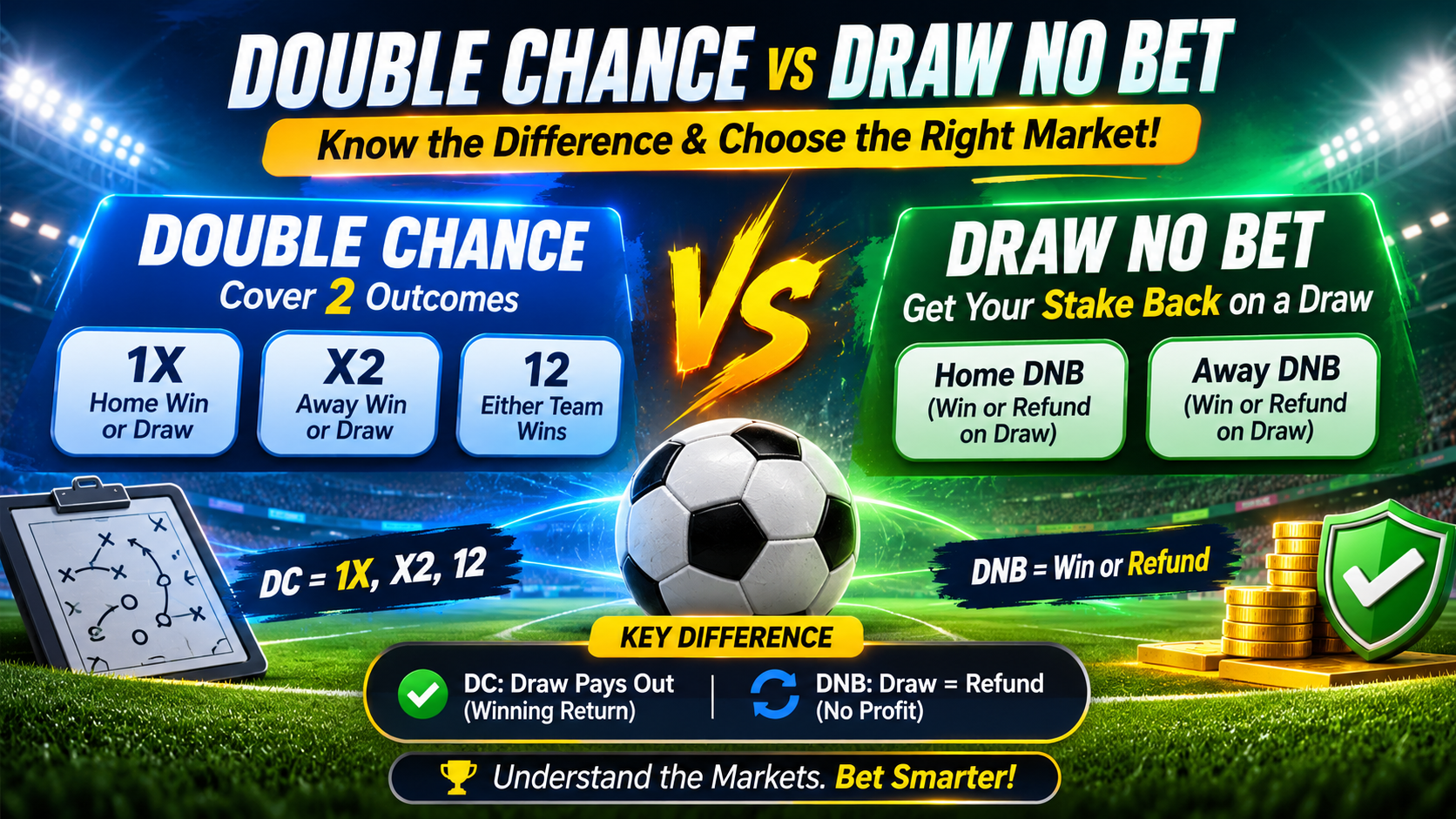
The football betting markets are similar until the match result determines the winner. Double Chance and Draw No Bet both provide an alternative to selecting the result of a match, but they settle differently; the former covers two possible match outcomes, and the latter refunds a stake if the match result is a draw under standard rules.
Understanding the differences helps the player to evaluate the market options and the odds on offer. For those who are new to the football markets at ufa and looking to get started, the definitions of these basic terms are a good place to begin.
What Is Double Chance in Football?
Double Chance (DC) allows one to pick two of the three standard match outcomes (home win, draw, away win). The market provides three options:
- 1X: The home team wins, or the match ends in a draw,
- X2: The away team wins, or the match ends in a draw,
- 12: A win for either team is a losing selection, but the draw is a winning outcome.
An example of the 1X selection is a win for the home team (2-0) or a draw (1-1). The choice would pay for a win (1-0) by the visiting team, but it would lose against an away win (0-1) since this outcome is not covered in the selection.
Since DC covers two possible match outcomes, the odds offered are generally lower than the odds of a single selection.
What Is Draw No Bet?
Draw No Bet (DNB) is a market where a player can select either the home team to win or the away team to win. The key difference between DNB and DC is the treatment of draws.
In a standard set of rules, there are three outcomes;
- Selected team wins: The stake wins at the quoted odds
- A draw: The stake is refunded
- Opposing team wins: The bet has lost.
It is important to note that a refund is not a winning return with profit; it is the return of the stake, which has not created a profit. The difference with DNB is that it provides a different outcome to a draw, which is not the case with DC; the draw outcome wins the 1X or X2 selection and produces a return at the quoted odds.
Double Chance vs Draw No Bet: Key Differences
The primary difference is the treatment of a draw resulting in a winning payout or a refund.
| Match result | Home Double Chance (1X) | Home Draw No Bet |
| Home team wins | Wins | Wins |
| Match is drawn | Wins | Stake refunded |
| Away team wins | Loses | Loses |
Both markets would lose when the player’s selection of the home team is beaten. However, DC 1X would pay out on the draw, but the home DNB stake would see a refund of the initial stake. For the same team and settlement period, the DNB will generally provide better odds than DC 1X since a draw does not create a profit. The prices would vary depending on the match and the bookmaker.
How Both Markets Work: A Match Example
Assume the player has placed a hypothetical bet of ₹100 on the home team at decimal odds of 1.80 in a DNB market.
- Home win: A gross return of ₹180 (including stake) with a net profit of ₹80
- Draw: The player gets their ₹100 stake returned with no profit
- Away win: The stake of ₹100 is lost.
Now, consider a separate bet of ₹100 on the home DC; the gross return for a draw, for example, at hypothetical odds of 1.30 will be ₹130 (including stake) with a net profit of ₹30. The prices quoted are not live prices, and they should serve only to illustrate the value of the draw settlement. The player should understand the market rules to make the right comparisons when it comes to choosing between markets based on value.
How to Read Odds and Choose a Market
Decimal odds indicate the total return for each unit staked, including the original stake. By multiplying the stake by the odds, the player will be able to calculate the gross returns. Subtracting the stake from the gross returns will give the net profit.
When reviewing the football markets, the player may come across terminology associated with UEFA Online (uefa ออนไลน์) and the discussion of the match outcome; when it comes to evaluating the options, understanding the difference between the competition results and the selected markets for that match is critical to interpreting the available markets correctly.
Before making the comparison, check the selection, the quoted odds, and the settlement period. The standard full-time result markets generally include stoppage time but exclude extra time and penalty shootouts unless the market rules state otherwise.
Final Takeaway: Which Market Fits the Match Scenario?
DC and DNB treat a draw outcome differently; under DC, 1X or X2 selection will produce a winning return, whereas under DNB, a draw will see the stake being refunded. The difference is in the settlement rules rather than the number of outcomes that the selection would cover, and the market choice should be reviewed based on the team and the odds on offer.
