

Most organizations that bring in outside help do so after something has already gone wrong. A resignation they didn’t see coming. A team dynamic that quietly fell apart. A talented employee who stopped performing and nobody could explain why. In many of these situations, the underlying issue wasn’t attitude, effort, or fit in the traditional sense. It was a mismatch between how a person thinks and how the environment was designed — a mismatch that went unexamined for far too long.
Neurodiversity in the workplace is not a new phenomenon. What is relatively new is the professional infrastructure to address it in a structured, non-clinical, operationally grounded way. That infrastructure includes a specific category of practitioner who sits somewhere between organizational psychology, workplace design, and human performance consulting. Before any organization commits to that kind of engagement, they deserve an honest account of what it actually involves — and whether it makes practical sense for them.
What a Neurodiversity Consultant Actually Does
A neurodiversity consultant works with organizations — and sometimes individuals — to identify where cognitive and neurological differences are creating friction, risk, or untapped capacity within a workplace or working relationship. This is not therapy. It is not HR compliance training repackaged. The work centers on how environments, workflows, communication systems, and management practices interact with the way specific people process information, manage energy, and perform under different conditions.
The role exists because most workplace systems were built around a fairly narrow cognitive template. Instructions, meeting formats, feedback structures, and performance metrics tend to assume a particular way of processing and responding. People whose neurology doesn’t match that template — those with ADHD, autism, dyslexia, dyspraxia, or other neurological variations — often spend significant mental energy compensating for the mismatch rather than doing the work itself. A neurodiversity consultant examines where those mismatches exist and what changes would meaningfully reduce them.
This is different from diversity and inclusion work in the broad sense. It is more specific, more operational, and more focused on the day-to-day mechanics of how people function within a given environment. The consultant may work directly with managers, with HR teams, with individual employees, or across an entire department, depending on where the friction actually lives.
The Difference Between Awareness Training and Functional Consulting
Organizations often confuse awareness training — a session that explains what autism or ADHD is — with consulting that actually changes outcomes. The former is informational. The latter is diagnostic and interventional. Awareness training can reduce stigma and build general goodwill, but it rarely changes the structural conditions that make a workplace difficult for neurodivergent employees.
Functional consulting goes further. It asks why a particular person is struggling, what specific conditions are contributing to that struggle, and what changes — to process, communication, physical environment, or management style — would produce a measurable shift. This requires time, observation, and a willingness to examine systems that most organizations consider fixed.
The Business Case Is Not What You Think It Is
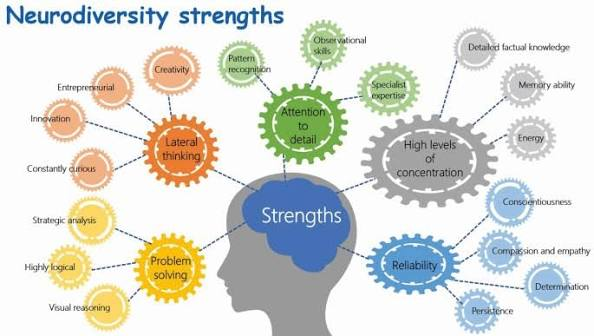
Most articles on this topic lead with the talent argument: neurodivergent individuals bring unique capabilities, pattern recognition, deep focus, creative problem-solving, and so on. That may be true in many cases, but it is not the primary reason to take this work seriously. The more grounded reason is operational risk.
When a workplace is poorly designed for cognitive diversity, it loses people — sometimes through formal exits, sometimes through disengagement that never appears on any report. The cost of losing an experienced employee is substantial. The cost of managing repeated performance issues that have structural rather than behavioral roots is also substantial. And the cost of never understanding why a team underperforms, despite capable individuals, adds up over years.
According to research documented by the World Health Organization, mental health conditions — many of which are closely associated with or exacerbated by unaddressed neurodevelopmental differences — are a leading cause of workplace disability globally. The connection between unacknowledged neurological difference and deteriorating mental health at work is not incidental. It reflects what happens when people are asked, repeatedly, to function in environments that are fundamentally misaligned with how they operate.
Retention Is Where the Numbers Show Up
Hiring neurodivergent employees without adjusting the environment they enter is not an inclusion strategy. It is a cycle. The person arrives, performs inconsistently relative to their actual capability, encounters friction that is never properly named, and eventually leaves or withdraws. The organization concludes the hire was a poor fit. In many cases, it was a poor fit between the person and the environment — not the role itself.
When consulting addresses the environment before or alongside the hire, retention improves not because the organization becomes more accommodating in a soft sense, but because the work conditions are designed to produce reliable output from a broader range of cognitive profiles. That is an engineering problem more than a cultural one, and it responds to engineering-style solutions.
Who This Work Is Actually For
There is an assumption that neurodiversity consulting is for large companies with formal DEI programs and dedicated HR infrastructure. That assumption is wrong in both directions. Small organizations often have more to gain because they cannot afford to lose key people, and every role carries more weight. At the same time, large organizations often have more structural problems because their systems are more rigid and their management layers are more numerous.
The work is most relevant when an organization is experiencing any of the following: high turnover in roles that should have low turnover, repeated performance issues in otherwise capable individuals, communication breakdowns that cannot be attributed to attitude or effort, difficulty retaining employees who were hired specifically for their specialist knowledge or skills, or managers who consistently struggle to support certain team members despite genuine effort.
These are not signals of a culture problem in the abstract. They are signals of a structural mismatch that is costing the organization in concrete, measurable ways.
Individual Engagements vs. Organizational Engagements
Some consulting engagements focus on an individual: a specific employee, a senior leader, or a business owner who is neurodivergent and wants their environment shaped around how they actually function. This is legitimate and often highly practical. A person who has spent years building compensatory strategies around a working style that doesn’t fit standard expectations can gain significant operational clarity from a consultant who understands how to design differently.
Organizational engagements are broader. They examine hiring practices, onboarding design, performance review structures, communication norms, physical workspace, and management training. These engagements take longer and require more organizational buy-in. They also produce more durable change because they address the system rather than asking individuals to keep adapting to it.
What to Expect From the Process
A credible consulting engagement does not begin with solutions. It begins with assessment. The consultant needs to understand the specific environment, the specific people involved, and the specific nature of the friction before any recommendations make sense. This phase typically involves conversations with managers and employees, review of existing processes, and sometimes direct observation of workflows or meetings.
From there, recommendations may range from small and immediate — adjusting how feedback is delivered, changing the format of team meetings, restructuring a role’s reporting requirements — to more substantial, such as redesigning an onboarding process or building a management framework that accounts for cognitive variation. The implementation timeline depends entirely on what the assessment reveals and what the organization is willing to change.
Measuring Whether It Worked
One of the honest limitations of this work is that impact can be difficult to attribute cleanly. People do not leave companies with a note explaining that the environment was neurologically incompatible. Engagement does not drop with a clear label attached. This makes before-and-after measurement challenging.
The most reliable indicators tend to be qualitative shifts that show up over time: managers reporting more consistent performance from previously erratic team members, fewer escalated HR situations involving the same types of complaints, employees describing their work environment as one where they can actually function. These are real outcomes, even if they resist neat quantification.
The Honest Limits of What Consulting Can Do
No consulting engagement will eliminate the fundamental diversity of human cognition, nor should it try to. The goal is not to make neurodivergent people perform identically to neurotypical ones. The goal is to remove unnecessary friction so that the actual work gets done and people can sustain their contribution over time.
Consulting also cannot substitute for leadership that is genuinely willing to change. If an organization brings in a consultant to signal openness without intending to implement anything, the engagement will produce a report that no one reads and a cycle that continues unchanged. The work requires a decision-maker who understands that some of what makes their environment difficult to work in is structural, not personal — and who is prepared to treat it that way.
Closing Thoughts
The honest answer to whether you actually need a neurodiversity consultant is this: if your organization is consistently losing capable people, struggling to get reliable output from individuals who are clearly intelligent, or cycling through the same interpersonal and performance problems without resolution, then the environment is part of the problem. That is worth examining with someone who understands the mechanics of cognitive difference and workplace design.
This is not about ideology or keeping pace with industry trends. It is about operational clarity. People perform better in environments designed to support how they actually function. That principle applies to ergonomics, to safety systems, and to cognitive load. An organization that ignores one of those categories while optimizing the others is leaving real performance on the table — and usually paying for it in ways that never show up as a line item.
The decision to bring in outside help should be made on the basis of specific, identifiable problems and a willingness to act on what the assessment reveals. If those conditions are in place, the engagement is worth serious consideration. If they are not, no amount of consulting will move the needle.
