

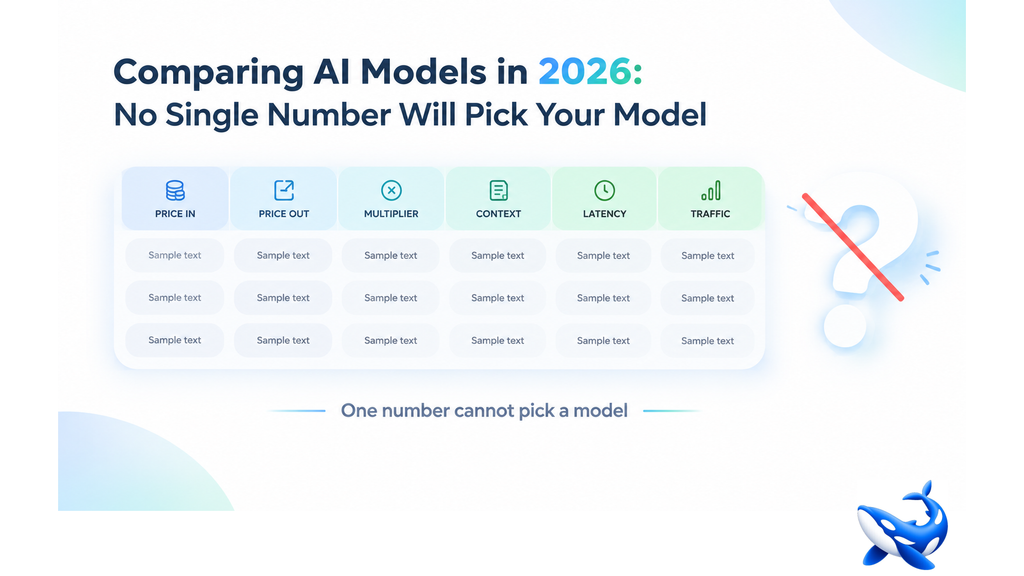
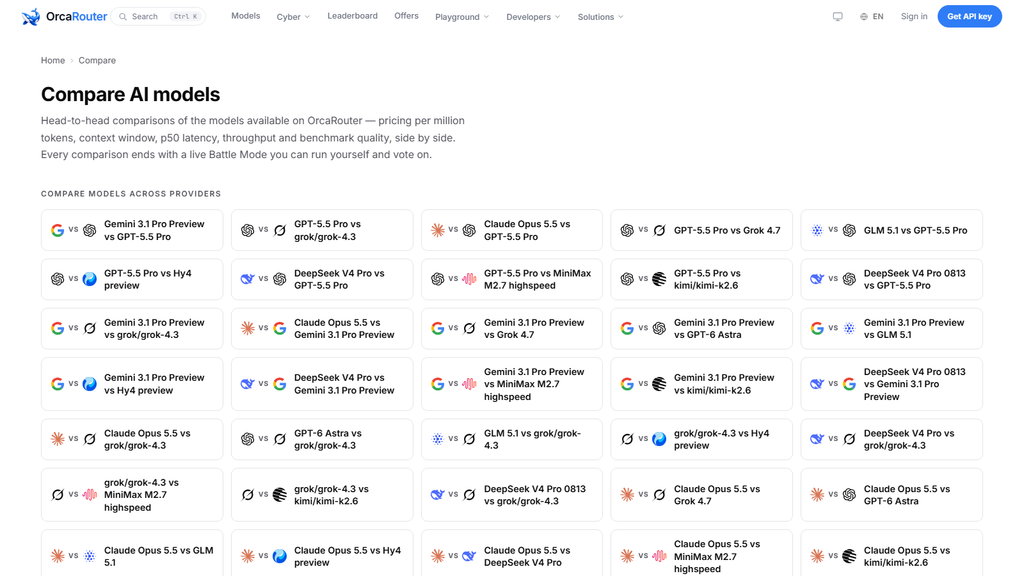
A model comparison in 2026 is not a verdict; it is a table, and the columns on that table are where the actual decision lives. On OrcaRouter the llm comparison page prints twelve models across a full set of columns, and the price column alone spans fifty-fold on input and ninety-one-fold on output — a range wide enough that no single which-is-best number can survive contact with it.
The question is not which model is best. It is which columns matter for the job you are actually pricing, and that is a question no leaderboard, no score, and no headline can answer for you.
The column that used to be a verdict
A decade ago a model review could fit in a headline: this one is the smartest, buy it. That worked when a handful of models competed and their capabilities moved slowly. The table in front of us now is a different animal. Twelve rows sit side by side, and the cheapest input price on the page is $0.60 per million tokens on MiniMax M2.7 highspeed while the dearest is $30.00 on GPT-5.5 Pro — the most expensive row in the table — a fifty-fold gap. The output column is even wider: $1.98 per million tokens on DeepSeek V4 Pro climbs to $180.00 on that same GPT-5.5 Pro row, roughly ninety-one times as much.
One score cannot represent that field. Even a perfect score can only tell you that a row belongs at the top of a quality ladder; it cannot tell you whether the row at the top of the ladder is worth fifty times the row near the bottom. The moment the price spread crosses a couple of orders of magnitude, a single which-is-best answer becomes a category error, and any comparison page that still pretends otherwise is selling you a headline instead of a table.
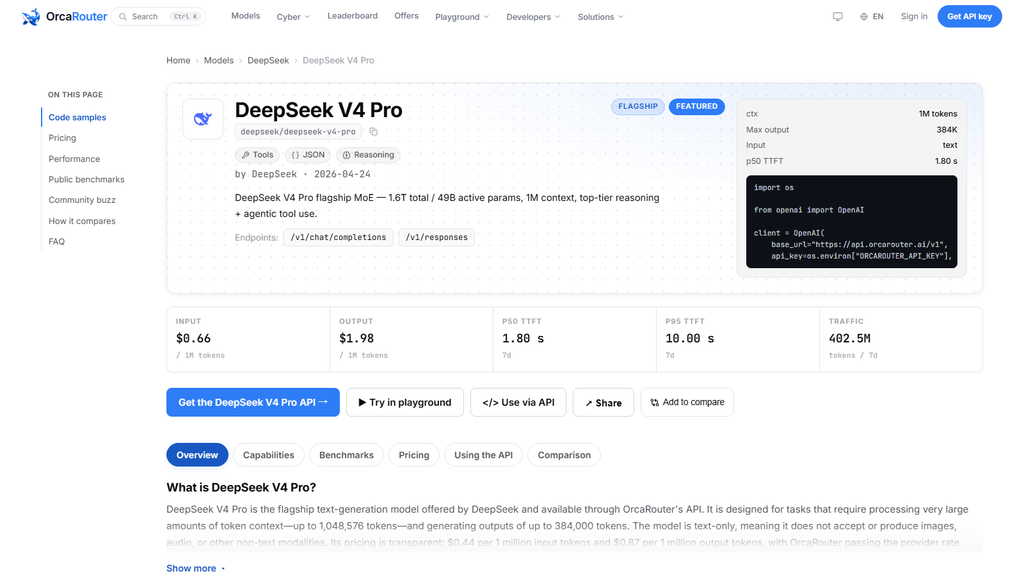
Read the input column down and the span becomes concrete. MiniMax M2.7 highspeed leads it at $0.60 per million tokens, with DeepSeek V4 Pro a cent behind at $0.66. Gemini 3.8 Flash follows at $0.75, kimi-k2.6 at $0.95, then a cluster at $2: Claude Sonnet 5.5, Gemini 3.1 Pro Preview, Grok 4.7 and GPT-6 Sol. GPT-5.4 sits at $2.50, Claude Opus 5.5 at $4, Claude Fable 5.1 at $10, and GPT-5.5 Pro tops the column at $30. The output side spreads wider still: DeepSeek V4 Pro’s $1.98 climbs through MiniMax M2.7 highspeed at $2.40, kimi-k2.6 at $4, Grok 4.7 at $6, a five-row cluster at $10 and $12, and up to $20 for Claude Opus 5.5, $50 for Claude Fable 5.1, and $180 for GPT-5.5 Pro. The cheapest row to feed is not the cheapest row to write, the dearest is dearest in both columns, and no single number can carry any of that.
Price, read twice
Every rate card carries two prices, and a comparison that collapses them into one number hides half the bill. The input price pays for the tokens you feed a model — your prompts, your documents, your conversation history. The output price pays for the tokens the model generates in return. The two are not interchangeable, and the cheapest row in one column is not the cheapest row in the other. MiniMax M2.7 highspeed takes the low end of the input column at $0.60 per million tokens, but its output price of $2.40 per million is beaten by DeepSeek V4 Pro, which charges $0.66 to read and just $1.98 to write. A reader-heavy application and a writer-heavy application will look at those two rows and see completely different price tags.
That is why the ratio between the two prices earns a column of its own. Across the twelve rows the output multiplier runs from 3.0 times to 6.0 times, and a multiplier that low is a different business than a multiplier that high. If your app writes more tokens than it reads, the multiplier does most of the arithmetic for you: a row that multiplies by six is charging you six output tokens’ worth of generation for every input token, and the number that lands on your invoice sits much closer to the output side of the equation.
Context and latency are real columns
The price columns are not the only ones doing the work. The context window tells you how much material a single request can carry, and the twelve rows do not agree on the answer: eight models claim a one-million-token window, while Grok 4.7 stops at five hundred thousand, kimi-k2.6 at two hundred sixty-two thousand, MiniMax M2.7 highspeed at two hundred five thousand, and GPT-5.5 Pro — the dearest row — does not publish a context number at all. A model that cannot hold your longest document is not a contender for that job no matter how well it scores.
The latency column does the same for interactivity. DeepSeek V4 Pro reaches its first token at a 1.76-second p50 in our production telemetry, while several rows sit pinned at the 10.00 second ceiling — the measurement ceiling, not a genuine latency, which is exactly why the same value shows up across most of the table. For an interactive product those two rows feel nothing alike, and the p50 is the column that tells you which one you are buying.
Quality is our composite, not a verdict
The quality column on our comparison page is a 0-to-10 composite that we build ourselves, scoring each model across our own quality dimensions — it is our measurement, not a third-party benchmark, and we say so every time the number appears. A composite is useful precisely because it is coarse: it tells you which tier a model belongs in without pretending to rank two models that land on the same digit. That is also its limit. When most of the field sits on the same side of a two-point spread, the composite stops being the deciding column and the rest of the table has to pick up the slack.
The column that tracks real money
The most underrated column on a 2026 comparison page is the one that shows actual usage. We publish each model’s seven-day token volume beside its price, and the numbers read like a market report. DeepSeek V4 Pro carried 512.0 million tokens in the trailing seven days, Gemini 3.8 Flash 335.5 million, GPT-6 Sol 125.1 million, and Claude Opus 5.5 close behind at 123.5 million. The dearest rows barely register: Claude Fable 5.1 at 7.4 million and GPT-5.5 Pro at 101.8 thousand. Teams vote with tokens, and a page that hides the vote hides the strongest signal it has.
The takeaway
A model comparison in 2026 has to show more than a winner. It has to show an input price and an output price, the ratio between them, a context window, a latency figure, a quality composite that explains what it is made of, and real traffic data — because each of those columns answers a different question, and the answers can point in different directions. One of the twelve rows is the cheapest to feed. A different one is the cheapest to write out. Several are the fastest to first token. And the most expensive row is, on our composite — the 0-to-10 score we build ourselves from the quality dimensions we grade each model on — a perfect 10, the same number as rows that cost a fraction of its price.
The wrong question is which is best. The right question is which columns matter for your workload, and then which row wins on those columns. Read the table that way and the single-number reviews stop being shortcuts and start being what they always were: somebody else’s answer to a question you did not ask.
Sourcing note: all twelve models, prices, output multipliers, context windows, p50 time-to-first-token figures, composite quality scores and seven-day token volumes are from the OrcaRouter comparison page and the linked model page, read 2026-10-12. The composite quality scores are our own, built by scoring each model across our own quality dimensions; they are not a third-party benchmark. Latency and volume figures are rolling telemetry that will drift, and the 10.00 s value is the measurement ceiling. All checked 2026-10-12.
