

Introduction
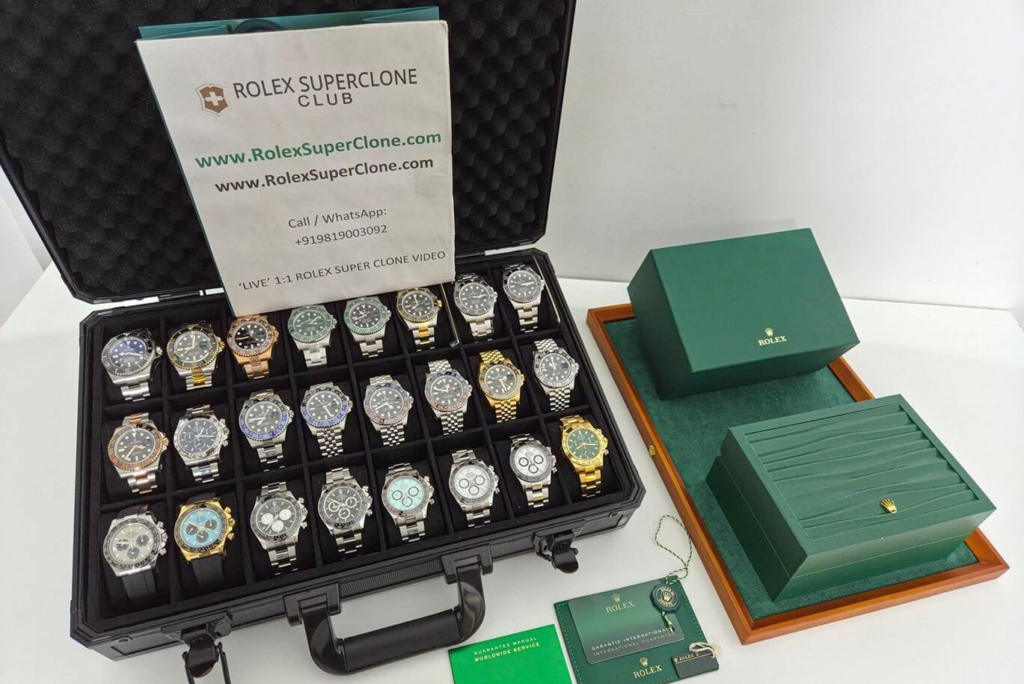
When people research 1:1 Rolex replica watches, they often focus on how closely a watch appears to match an authentic Rolex. Terms such as Rolex super clone, high-quality replica, Swiss movement, automatic movement, ceramic bezel, sapphire crystal, and detailed finishing are commonly used in discussions about replica watches. However, appearance alone does not establish authenticity, quality, or value. A careful evaluation requires looking at several watch details together, including the dial, case, bracelet, movement, crystal, bezel, crown, and overall finishing. Understanding these elements can help readers make more informed decisions and recognize the differences between an authentic luxury timepiece and a counterfeit product. It is also important to remember that Rolex is a protected brand, and replica products can raise trademark, consumer protection, and customs issues depending on where they are bought, sold, or imported. For that reason, researching watch construction should be approached as an educational exercise rather than simply relying on marketing descriptions. The phrase 1:1 Rolex replica watches suggests that a replica has been made to closely imitate an original model, but there is no universal technical standard that makes a replica genuinely “1:1.” Quality can vary widely between manufacturers and individual watches, and claims about materials or movements should always be treated carefully.
Examining the Dial and Markings
The dial is one of the first areas to inspect because it contains many small details that can reveal differences between an authentic watch and a replica. On a genuine Rolex, hour markers, text, logos, minute tracks, and other dial elements are produced with a high level of precision. Spacing and alignment are consistent, while the printing is generally clean and sharply defined. When evaluating 1:1 Rolex replica watches, readers may encounter claims that a particular dial is identical to the original, but visual similarity does not prove that claim. Small differences can appear in lettering, marker placement, date-window positioning, or the finish of applied elements. Magnification can make these differences easier to notice. The hands should also align correctly with the dial and operate smoothly. On models with a date display, the date should sit properly within its window rather than appearing noticeably shifted. These details are useful for understanding watch craftsmanship, but they should not be treated as a single definitive authenticity test. Counterfeit manufacturers can reproduce many visible features with increasing accuracy, which is why a professional inspection is more reliable when authenticity matters.
Checking the Case, Bezel, and Crystal
Case construction provides another useful area for comparison. An authentic Rolex has carefully finished surfaces, with polished and brushed sections that transition cleanly from one area to another. The shape of the lugs, crown guards, case profile, and caseback can also differ between models, so comparisons should always be made against the correct reference. Discussions surrounding a Rolex super clone often highlight details such as case dimensions, ceramic bezels, or sapphire crystal. These components can influence the appearance and feel of a watch, but their presence does not automatically confirm authenticity. Sapphire crystal, for example, is widely used across the watch industry and is not exclusive to Rolex. Likewise, ceramic bezels are found on many modern watches. A careful evaluator should look at how components work together instead of treating one material as proof of quality. Bezel alignment is also worth observing. Markers should line up appropriately, and rotating bezels on applicable models should operate consistently. Case finishing should feel deliberate rather than rough or uneven. These observations can help assess general manufacturing quality without assuming that a visually convincing replica is equivalent to the original luxury product.
Understanding the Movement
The movement is one of the most important parts of any mechanical watch because it controls timekeeping and many other functions. Authentic Rolex watches use proprietary movements developed and manufactured according to Rolex’s specifications. Replica watches may use various third-party automatic movements or modified mechanisms, and descriptions such as “Swiss movement” or “clone movement” can have different meanings depending on the seller and manufacturer. This is especially important when evaluating claims surrounding 1:1 Rolex replica watches, because movement terminology can sound more precise than it really is. A watch that uses a movement designed to imitate the appearance or operation of a Rolex caliber is not automatically using the same movement as an authentic Rolex. Checking movement specifications requires technical knowledge, and opening a watch can also cause damage if done incorrectly. For anyone concerned about authenticity, a qualified watchmaker is better positioned to examine the movement and compare its construction with the expected caliber. Accuracy, power reserve, winding behavior, and automatic rotor movement can provide useful information about mechanical performance, but none of these characteristics alone proves that a watch is genuine. A well-made counterfeit can perform reasonably well while still being unauthorized and non-authentic.
Evaluating the Bracelet and Overall Finishing
The bracelet is another important part of the watch because it contributes significantly to comfort, durability, and overall appearance. Authentic Rolex bracelets are engineered with precise links, clasps, tolerances, and finishing. Brushed and polished surfaces should have consistent textures, while the clasp should operate smoothly and feel solid. When researching 1:1 Rolex replica watches, descriptions may emphasize bracelet weight or construction as evidence of quality. Weight can be useful for comparison, but it is not a reliable authenticity test because counterfeit manufacturers can alter materials and dimensions to approximate an original. Instead, it is more useful to examine the overall construction and compare it with verified reference information. The connection between the bracelet and case should also be clean, without obvious gaps or poor alignment. Sharp edges, inconsistent brushing, loose links, or an uncomfortable clasp can indicate weaker manufacturing quality. At the same time, excellent finishing does not turn a counterfeit into an authentic Rolex. The distinction between craftsmanship and brand authenticity is important. A watch can be mechanically functional and visually impressive while still lacking the provenance and legitimacy associated with a genuine luxury timepiece.
Making a Careful and Informed Assessment
Evaluating a watch properly means considering multiple details rather than trusting a single feature or a product description. The term 1:1 Rolex replica watches is primarily a marketing phrase rather than an independent certification, so buyers and researchers should be cautious when they see claims that a replica is “exact,” “identical,” or impossible to distinguish from an original. Photographs can also hide small construction differences, making in-person inspection more useful when authenticity is important. Documentation, serial information, purchase history, and professional verification can provide stronger evidence than promotional language. Anyone considering a pre-owned Rolex should be especially careful with unusually attractive offers, incomplete provenance, or sellers who avoid independent authentication. It is also wise to understand local laws concerning counterfeit goods before purchasing or importing anything carrying a protected trademark. For people interested in watch collecting, learning about genuine Rolex references, movement families, materials, case dimensions, bracelet designs, and historical changes can provide a much stronger foundation than relying on replica terminology. A professional watchmaker or authorized service provider can offer an expert assessment when there is genuine uncertainty.
Conclusion
Understanding watch details is valuable whether someone is studying Rolex designs, comparing luxury watches, or trying to identify a counterfeit. 1:1 Rolex replica watches may imitate many visible characteristics of genuine models, but no label can guarantee that a replica is truly identical to an authentic Rolex. Dial precision, case finishing, bezel construction, crystal type, bracelet quality, and movement design can all provide useful clues, yet authentication requires looking at the complete watch and its supporting evidence. A Rolex super clone may be described as highly accurate in appearance, but visual accuracy should not be confused with authenticity, official manufacture, or authorized provenance. The safest approach is to treat replica terminology as a description of imitation rather than a recognized quality certification. By learning how genuine watches are constructed and by relying on qualified professionals for authentication, readers can develop a more accurate understanding of luxury watch quality and avoid making decisions based solely on promotional claims.
